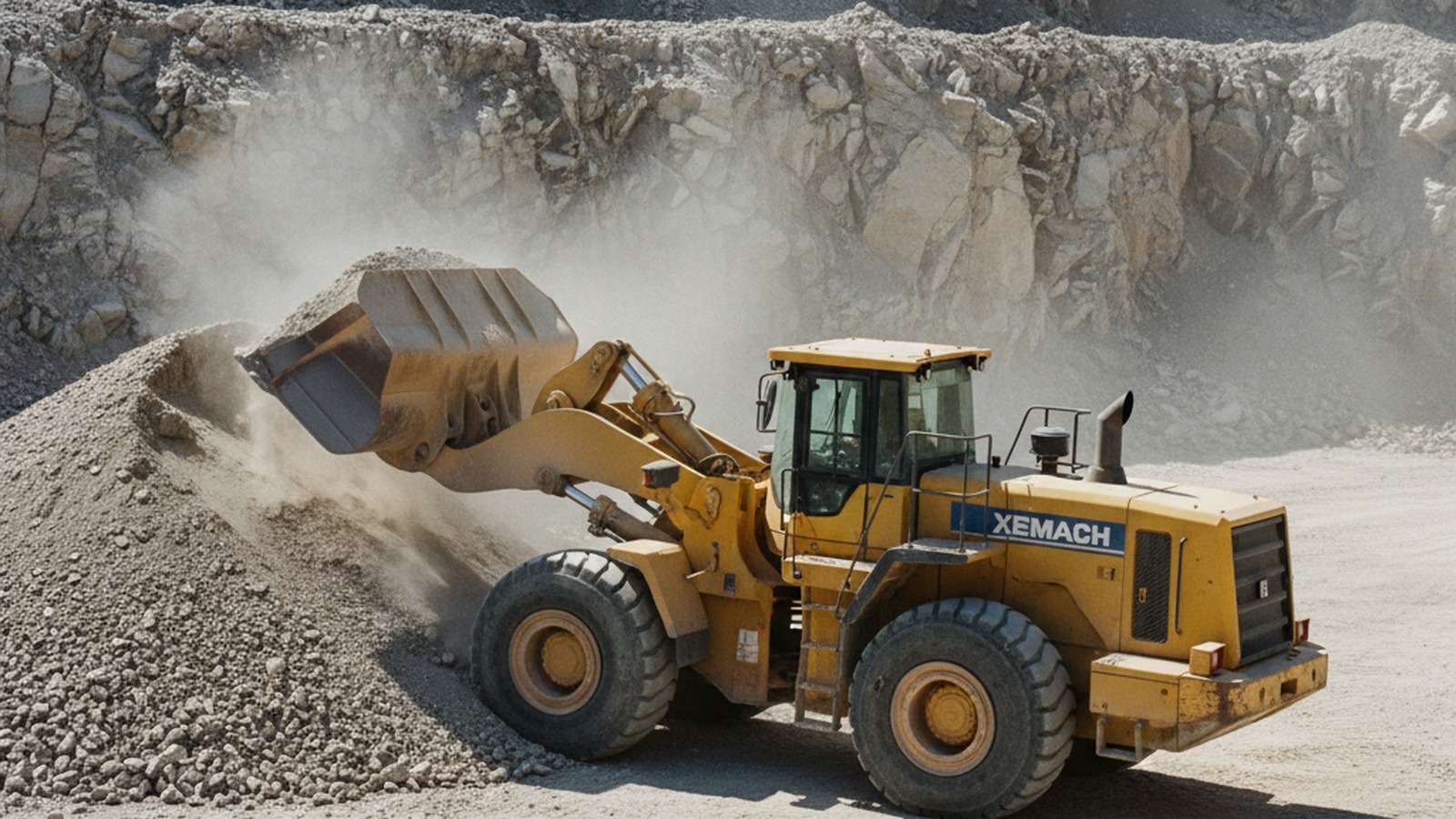
At 6:15 a.m., a quarry loader starts its shift at the face. Trucks are lined up, the crusher feed plan is already tight, and nobody on site cares which brochure promised the biggest number. What matters is simpler: how fast the loader fills, whether it keeps traction in the pile, how many passes each truck needs, and whether it can finish the day without an unscheduled stop.
That is why the latest round of large wheel loader news matters. Recent market coverage shows a clear pattern: buyers in quarry and aggregate work are no longer judging production loaders by horsepower or bucket size alone. The conversation is moving toward cycle efficiency, fuel burn per ton moved, operator consistency, and service access that actually works in dust-heavy conditions.
When one extra pass per truck becomes a fleet problem
In high-volume loading, small inefficiencies stack up fast. If a wheel loader needs one more pass to top off a truck, the cost is not limited to a few extra seconds. It affects queueing, truck use, crusher rhythm, fuel use, tire wear, and operator fatigue.
That is why payload still matters, but payload alone is no longer enough. The stronger question is whether the machine can deliver repeatable bucket fill, stable breakout performance, and fast reversals without forcing the operator to fight the machine all day. Recent product launches and model updates point in the same direction: loaders are being tuned for consistent cycles, not just peak spec-sheet output.
What buyers should check before focusing on headline specs
Quarry buyers still need the basics right: bucket size, tipping load, power, and match with haul trucks. But current market signals suggest a smarter buying checklist.
- Low-end torque and hydraulic response matter because dense piles punish slow reaction.
- Transmission behavior matters because smoother acceleration and cleaner power delivery reduce wasted motion in every cycle.
- Visibility matters because loading zones are crowded and reverse travel is constant.
- Service layout matters because dust turns neglected maintenance into downtime very quickly.
- Tire wear and traction management matter because they shape operating cost more than many buyers admit.
In other words, a loader should be sized for the material flow, not just purchased as the biggest machine the budget can tolerate.
Why drivetrain choices are getting more attention
One of the strongest themes in recent wheel loader coverage is drivetrain design. Traditional thinking treated the drivetrain as background hardware. That is changing.
Manufacturers are putting more emphasis on hybridized or electrically assisted drive concepts, hydro-mechanical layouts, and control logic that separates hydraulic performance from raw engine speed. The reason is practical. Quarry sites want full digging force and responsive hydraulics, but they also want lower fuel burn, smoother machine behavior, and less operator-induced variability.
The interesting part is that the market is not waiting for fully battery-electric production loaders to solve everything. In the near term, the bigger shift is toward smarter diesel platforms with electric-assist or electronically managed transmission systems. That approach fits the reality of quarry work, where uptime, range, and steady output still outrank experimental powertrains.
One recent launch in the large loader segment claimed fuel savings of up to 15% in its efficiency mode, along with a smaller productivity gain in a higher-output setting. Even if real-world numbers vary by operator and material, the direction is clear: drivetrain efficiency is now a buying argument, not an engineering footnote.
Uptime now starts in the cab and under the service door
A production loader can look strong on paper and still lose money if daily service is awkward or if the operator struggles to place material cleanly. That is why current designs keep pushing on two fronts at once: operator awareness and maintenance access.
Better sightlines, rear object detection, camera systems, and cleaner in-cab displays are not cosmetic upgrades for quarry work. They help reduce hesitation during reverse travel and truck approach, which protects cycle speed and jobsite safety.
The same logic applies to grouped maintenance points, easier ground-level access, and telematics that flag problems before failure. Dusty quarry conditions punish filters, cooling systems, pins, bushings, and tires. A machine that saves time during inspection and catches issues early can outperform a more powerful machine that spends too much time waiting on service.
The next buying split: more tons per hour, or lower cost per ton?
This is the decision many fleets are really making now. Some operations still need the heaviest setup possible to keep large haul units fed. Others are asking a more disciplined question: can a slightly smarter machine move nearly the same tonnage while cutting fuel, tire wear, and maintenance disruption?
That is where the market is getting more specific. The best machine for a quarry is no longer defined only by maximum size. It depends on haul truck match, material density, ramp conditions, operator skill, shift length, and whether the site is trying to push absolute output or improve cost per ton.
From XeMach's side, the takeaway is straightforward: the next competitive wheel loader will not win on one big number. It will win by making each pass easier to repeat, each service interval easier to manage, and each ton cheaper to move. Quarry customers are buying a loading system now, not just a loader.