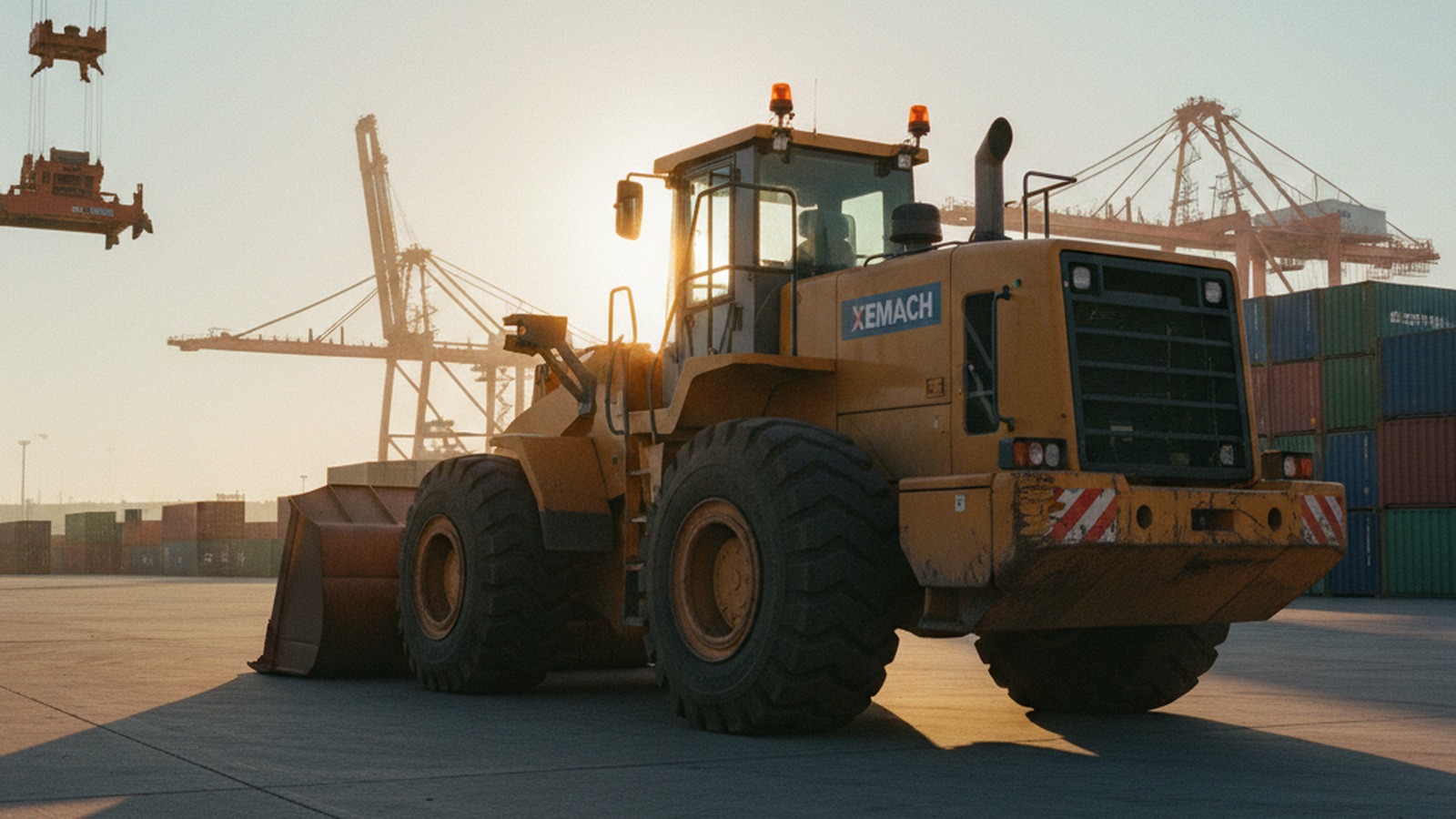
At 6:30 in the morning, a loader operator in a city recycling yard starts the same loop for the hundredth time: stockpile, hopper, reverse, repeat. The machine stays inside a defined work zone, noise matters because apartments are close, and the shift has a predictable finish. That is exactly the kind of job where battery power stops being a demo and starts looking like a real fleet decision.
Electric construction equipment is still a small market, especially in North America. Construction Equipment recently estimated that electric earthmoving machines make up only around 1 percent of U.S. unit sales. But the interesting part is not the headline number. It is where adoption is actually taking hold. Right now, the clearest answer is wheel loaders.
Why loaders have become the first real test case
A lot of equipment categories talk about electrification. Fewer have a job cycle that makes the math work. Wheel loaders do.
Compared with many excavator applications, loader work is often more repetitive and easier to map against battery use. Load, carry, dump, return. The route is short, the cycle is visible, and the machine usually comes back to the same operating base. That makes charging easier to plan, whether the machine is working at a port, a materials yard, a transfer station, a quarry support area, or a tightly managed industrial site.
This matters because the biggest barriers to electric adoption have not changed: runtime, charging access, and application fit. In a loader application with a known cycle and a known parking point, those barriers are easier to manage than they are on a spread-out site where the machine moves constantly between tasks.
Excavators are part of the story, but not the lead chapter
Electric excavators get more attention than loaders because they are easy to picture in urban jobs, indoor demolition, and utility work near schools or hospitals. That is real demand, and compact excavators still make good early electric candidates.
But market data suggests excavators are not scaling as quickly. Interact Analysis, cited by Construction Equipment, reported that electric excavator adoption remains largely concentrated in mini excavators, while 2025 production was flat to down across most OEMs. In other words, electric excavators have proven the concept in smaller classes, but they have not yet become the first broad-volume segment.
Wheel loaders look different. According to the same research, the segment has already moved beyond the earliest adoption phase and into genuine competitive scale, especially in China. That is a big line to pay attention to. Once a category moves from pilot projects to real production scale, the conversation changes from “Can this be built?” to “Who can deliver consistently, service it, and make the economics hold up?”
What makes the wheel loader duty cycle more forgiving
There is no magic here. The machine still needs enough battery, enough charging, and enough uptime. But several practical details work in the loader's favor.
First, loader cycles are usually repetitive. Energy draw is easier to predict when the machine is doing the same short haul over and over instead of traveling across a large site and shifting between unpredictable tasks.
Second, loaders often work where power access is more realistic. Municipal depots, recycling yards, ports, aggregate terminals, enclosed industrial sites, and mine-adjacent infrastructure areas are all better charging environments than remote greenfield projects.
Third, electric loaders can deliver value beyond fuel savings. Lower noise helps in urban and regulated environments. Fewer routine engine-related service items can reduce maintenance complexity. Smooth torque delivery also suits repeated loading work.
That does not mean every loader job is ready. High-travel applications, remote quarries without charging support, and multi-shift sites with little downtime still create a tough case for batteries. But the point is simpler than that: wheel loaders already have enough suitable applications to build real market volume.
China is shaping the pace of the segment
One of the more important points in the recent market coverage is geographic. The fastest movement is not happening evenly across regions.
Construction Equipment's April reporting, based on Interact Analysis, says the Chinese wheel loader market is shifting toward electric powertrains much faster than the U.S. market. It also notes that larger Chinese wheel loaders, typically above 55 kW, are leading adoption, supported by charging infrastructure already developed around electrified mining equipment and by shared battery and powertrain platforms.
That combination matters. It means some manufacturers are not treating electrification as a one-off compliance product. They are building around platform reuse, supply-chain scale, and actual fleet demand. When that happens, price, parts support, and product maturity usually improve faster.
For buyers outside China, the immediate takeaway is not that every market will move at the same speed. It is that the competitive benchmark for electric loaders is being set by machines that are designed from the start for battery use and built in real numbers.
The next question is not whether electric loaders exist
That question is over. They exist, and in some regions they are already working in meaningful numbers.
The better question is where they outperform diesel strongly enough to justify the switch.
Three cases stand out.
- Fixed-route loading in urban or noise-sensitive environments
- Yard, port, and industrial handling where overnight charging is easy to schedule
- Fleets under emissions pressure that can centralize charging and technician support
Outside those cases, diesel still has plenty of room. That is especially true when the site is remote, duty cycles are harsh, or uptime requirements leave no margin for charging delays.
Why this matters for the rest of earthmoving
Wheel loaders may end up doing more than winning their own segment. They may become the market's proof point for what scalable electrification actually looks like in heavy equipment.
If a machine category can reach repeatable economics, dealer support, and operator acceptance, it gives the rest of the market a pattern to follow. Excavators, telehandlers, and dump trucks all have their own path and constraints. Some will move slower. Some may leap ahead in niche applications. But loaders are showing something useful right now: electrification works best when the job cycle is predictable, the infrastructure is close, and the value is operational, not ideological.
From XeMach's view, that is the practical lesson worth watching. The next wave will not be decided by who talks most about electric machines. It will be decided by which equipment categories solve real work first. Today, wheel loaders look like one of the clearest places where that is starting to happen.