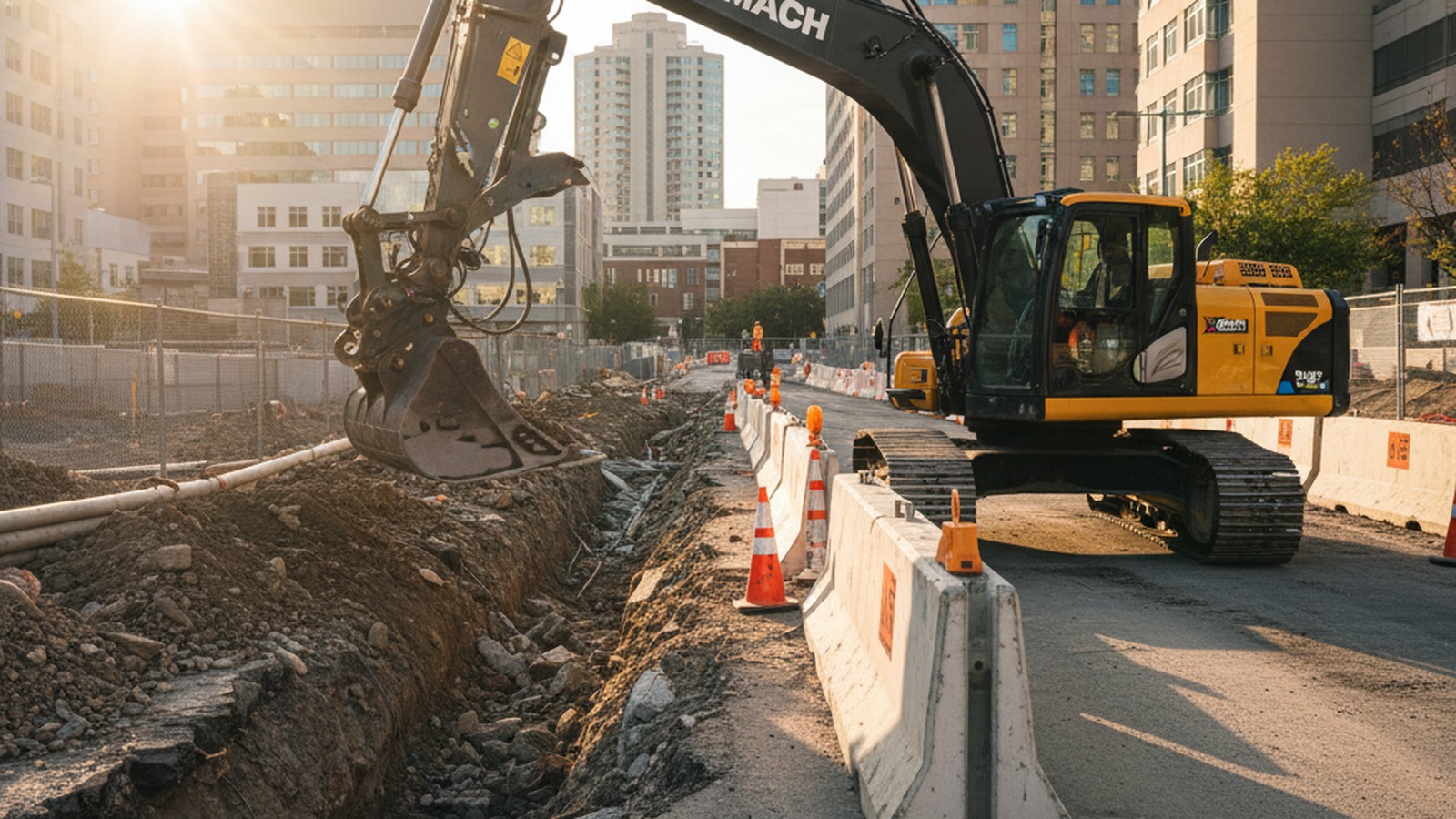
At 6:30 in the morning, a utility crew is asked to open a narrow trench beside a hospital loading bay, finish before midday deliveries pile up, and keep noise low enough that nearby wards do not complain. That is the kind of job where electric equipment stops being a conference talking point and starts being an operating decision.
The near-term win is still compact excavators
The latest wave of electric mini excavators shows where battery power works today without forcing contractors to pretend physics has changed. A newly introduced 2.5-ton electric mini excavator in North America, for example, is being positioned around the jobs that already fit the profile: hospitals, schools, city centers, enclosed areas, and other sites where noise, fumes, and ventilation requirements create real cost and access problems.
The machine details matter less than what they say about the segment. Roughly four to eight hours of working runtime, overnight charging, retractable undercarriages for tight access, and compatibility with common attachments all point to the same conclusion: compact excavators are moving into a practical adoption phase, not a speculative one.
That does not mean every buyer should rush out and replace diesel units. It means electric mini excavators now make sense when the workday includes idle time, frequent repositioning, short bursts of digging, and a reliable place to charge at night. In those conditions, quieter operation and simpler maintenance are not soft benefits. They can decide whether a contractor wins the job.
Bigger dump trucks are finally leaving the prototype stage
The more important signal this month may actually be outside compact equipment. Serial production has begun for 30-ton and 40-ton electric articulated dump trucks in Europe, a step that matters because it moves electrification into heavier, higher-use earthmoving cycles.
This is still not a universal diesel replacement story. Large dump trucks have demanding payload expectations, long duty cycles, and harsh energy requirements. But the move from demonstration units to serial production changes the conversation. In quarrying, mining support, and controlled site haul roads, the industry is starting to test whether repeatable routes and planned charging windows can make larger battery machines economically credible.
That is a different milestone from showing an electric machine at an exhibition. It suggests some fleets are now ready to judge electric dump trucks on uptime, haul cycle stability, and total operating cost rather than novelty.
Why China, Europe, and North America are moving at different speeds
Recent market analysis makes one thing clear: there is no single global electrification curve for construction machinery.
China is ahead in battery-electric wheel loaders, where demand, charging infrastructure, and product scale are lining up faster than many Western markets expected. Europe is moving early where emissions pressure and site restrictions are strong. North America, by contrast, still looks selective and cautious.
That matters for excavators and dump trucks too. The market is rewarding machines that are designed from the start as electric platforms, not diesel models with batteries stuffed into the old architecture. Purpose-built layouts usually offer better packaging, cleaner thermal management, and a more believable path to scaling production. Retrofit machines can help prove demand, but they do not always set the pace for the next generation.
For XeMach and other manufacturers watching the market, the lesson is pretty straightforward: electrification is not spreading evenly by region or by product class. The winners will be the companies that match machine design to the right application first, then scale around it.
What buyers should ask before they call a machine “electric-ready”
A lot of equipment discussions still get stuck at headline claims. Buyers should press deeper:
- What does runtime look like in the actual duty cycle, not a brochure average?
- Can the site support overnight or mid-shift charging without expensive temporary power work?
- Will attachments, grade resistance, or continuous high-load operation cut battery performance harder than expected?
- Is the machine replacing a diesel unit on a restricted site, or being asked to do a diesel machine’s unrestricted job?
- Does the supplier have the service capability to support batteries, controls, and thermal systems in the local market?
Those questions sound basic, but they are where good purchasing decisions are made. Electric equipment succeeds when the jobsite is planned around its strengths. It struggles when buyers expect it to behave like diesel with a different fuel tank.
The next phase will be decided by application discipline
From XeMach’s side of the market, the smartest way to read this moment is not to ask whether electric construction equipment has “arrived.” It has, but only in certain lanes.
Compact excavators are proving themselves where access, sound limits, and indoor or urban work create clear advantages. Electric dump trucks are becoming credible in sites with repeatable haul patterns and controlled energy planning. Wheel loaders remain the segment to watch for scale, especially in markets where charging infrastructure and use rates are already favorable.
The next 12 to 24 months will probably not produce one universal answer. They will produce clearer boundaries. And that is good for buyers. The industry does not need louder promises right now. It needs machines that fit the job well enough to earn their place shift after shift.