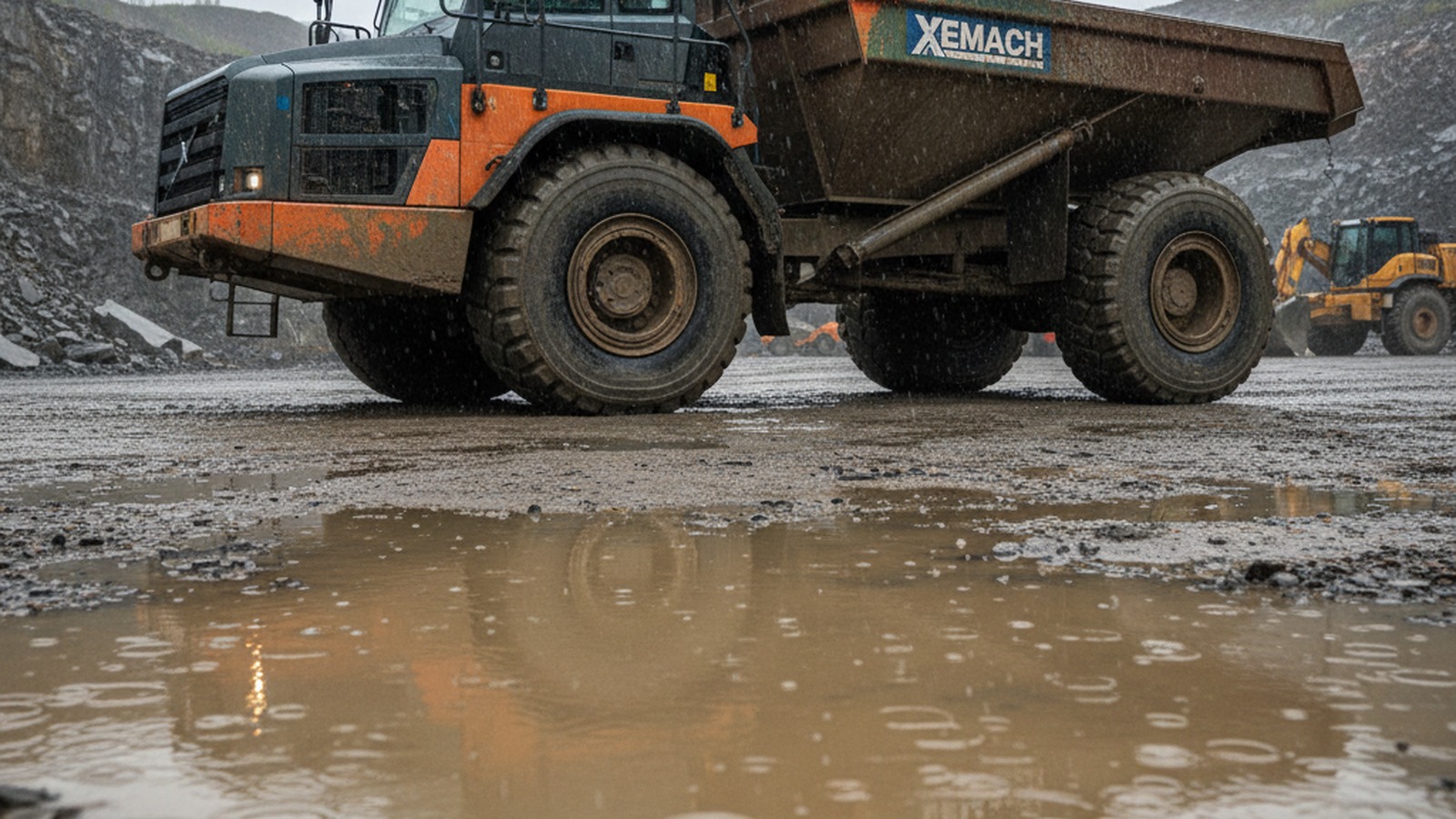
A loaded articulated dump truck starts climbing out of a muddy cut after overnight rain. The operator is not thinking about top speed. He is thinking about one thing: whether the truck will keep moving straight, stay planted on the grade, and let him see enough around the machine to finish the cycle without drama. That is why the most interesting change in the ADT market right now is not a headline horsepower race. It is the way traction control, braking logic, and visibility systems are becoming central to machine value.
The haul-road problem has changed
For years, ADT buying conversations leaned heavily on payload, engine output, and cycle time. Those numbers still matter. But recent industry coverage shows that manufacturers are now competing much harder on control in bad ground conditions. That shift makes sense.
Many earthmoving and quarry jobs are not limited by straight-line speed. They are limited by rain, soft haul roads, changing grades, operator fatigue, and how much confidence the driver has when the machine is fully loaded. A truck that spins tires, slides too easily on descent, or forces the operator to guess what is happening around the rear frame can lose more real productivity than a small gap in rated power ever would.
One recent 46-ton-class ADT launch illustrates the direction of travel. The new truck gained payload, but the more telling story was its traction package: continuous wheel-slip monitoring, automatic brake intervention at individual wheels, differential lock coordination, automatic retard speed control, hill-start assist, and a wider-glass cab intended to reduce blind spots. In other words, the machine was sold as a control system as much as a hauler.
Why smarter traction matters more than another spec-sheet bump
On paper, traction aids can look like another long list of electronic features. In the field, they change the economics of a shift.
When wheel slip is managed automatically, the truck wastes less power digging for grip. Tire spin goes down, tire life tends to improve, and operators can hold more consistent travel on soft, uneven, or greasy surfaces. That matters because unstable travel does not just slow one cycle. It ripples across the loading area, the haul road, and the dump point.
The same applies on downhill runs. Modern ADTs increasingly blend service brakes, engine braking, transmission retarders, and automated control logic so operators do not have to manage each input manually every time conditions change. Less overheating, less brake abuse, and fewer abrupt speed corrections usually translate into steadier production. It also lowers the skill penalty for newer operators, which is increasingly important in a labor market that is not getting easier.
This is the bigger market lesson: ADT development is moving away from brute force alone. Buyers still want power, but power without intelligent control is now a weak value proposition on mixed-terrain jobs.
Visibility is no longer a comfort feature
The visibility story is just as important. Rear cameras used to feel like a box-checking feature. Now the market is moving toward multi-camera systems, dynamic views that respond to articulation, surround monitoring, and object alerts that are designed to reduce struck-by risk in crowded work zones.
That matters because ADTs are working in tighter and busier environments than many buyers admit. Quarries remain a core application, but urban earthmoving, utility support, roadbuilding support, and large infrastructure sites all put more people, vehicles, and temporary obstacles around the truck. Better visibility is not only about compliance or operator comfort. It directly affects how confidently a fleet can maintain pace without building unsafe habits into the cycle.
A useful detail from recent product reporting is that cab design changes are being sold in measurable terms, not vague language. More glass area, fewer blind spots, better monitor layouts, and easier access to rear-view or payload data are becoming part of the purchase argument. That is a sign the market has matured. Fleet owners are no longer treating visibility as a soft benefit.
What fleet buyers should ask before the next ADT order
If the latest product releases are any guide, the smartest ADT conversations in 2026 will sound more practical than glamorous. Buyers should push for clear answers on a few points:
- How does the truck detect and respond to wheel slip?
- What braking systems work together during descent, and how much is automated?
- Does the machine offer hill-hold or hill-start assist on loaded grades?
- What visibility package is standard, and what changes with optional cameras?
- Does the camera view adapt as the machine articulates?
- How are traction events, brake health, and machine condition reported through telematics?
- Can the control systems reduce tire wear, spillage, or operator variability enough to change cost per ton?
Those questions get closer to real ownership value than a simple brochure comparison. On a hard, dry haul road with experienced operators, several trucks may look similar. In mud, on a ramp, or on a mixed-skill crew, the gaps get bigger fast.
The ADT market is quietly redefining productivity
There is a simple reason this theme is worth watching: safety systems and productivity systems are starting to overlap. Better traction reduces wasted motion. Better braking control protects components and keeps speeds consistent. Better visibility lowers stress and gives the operator a cleaner, faster picture of the jobsite. These are not side benefits anymore. They are part of the production package.
From the XeMach side of the table, this is where ADT demand is becoming more interesting. Buyers are still comparing payload and fuel burn, but the stronger long-term signal is machine composure under load. The next purchase decision will increasingly go to the truck that stays predictable on wet ground, holds speed on grades, and gives the operator a clearer view when the site gets messy. That is not flashy marketing. It is what keeps material moving.