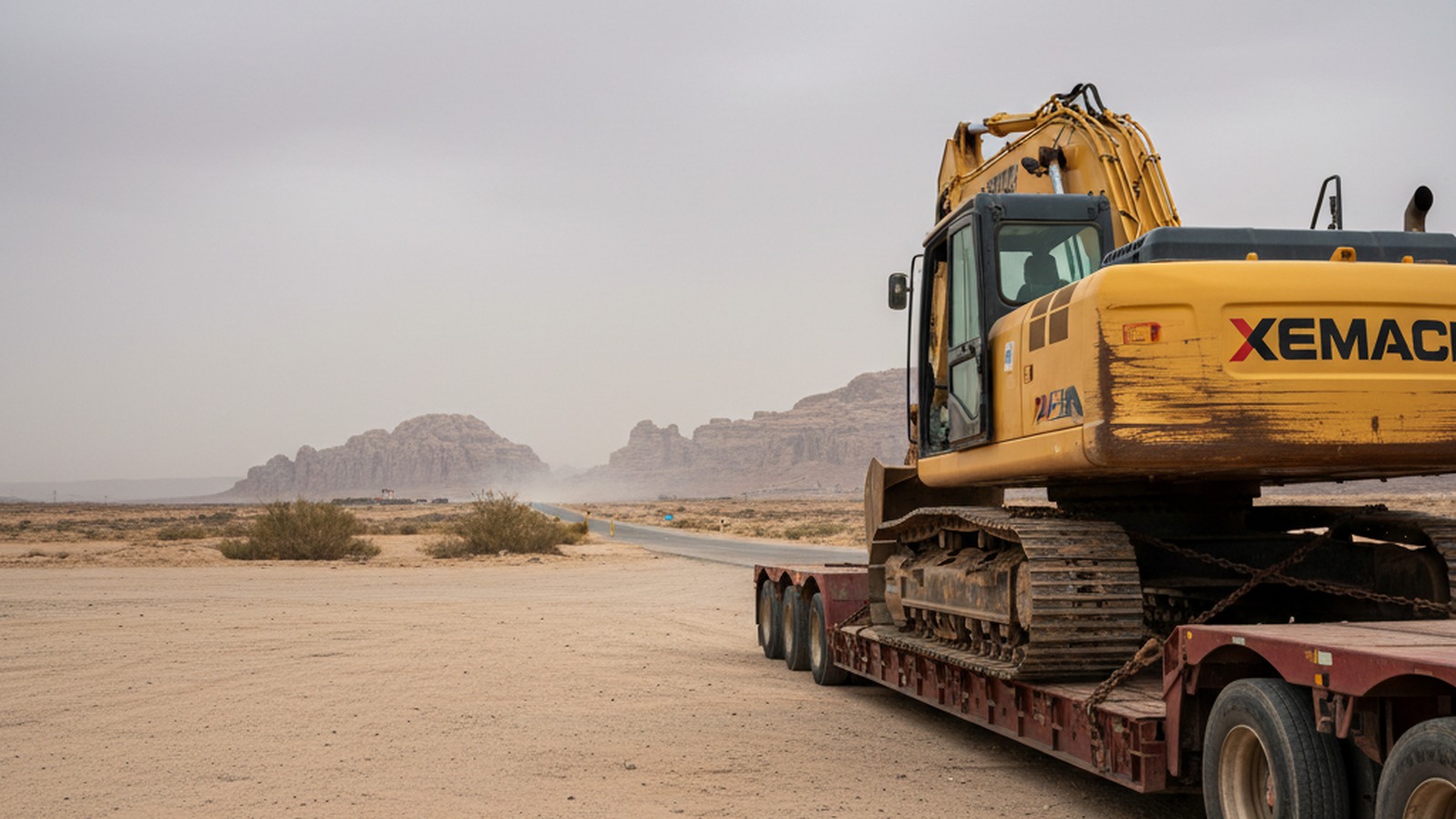
A distributor in the Gulf has already paid for three crawler excavators, two wheel loaders, and a batch of dump-truck components from China. The machines are ready at origin, but the shipping plan was built around Gulf calls inside the Strait of Hormuz. If that corridor becomes unavailable, the question is not whether the order can move. It is how fast the route can be rebuilt without losing weeks to re-booking, inland transfers, customs friction, and surprise surcharges.
For buyers of excavators, wheel loaders, and dump trucks, a Hormuz closure scenario would not end deliveries to the Middle East. It would shift the job from a simple port-to-port shipment into a multimodal project. Recent operator updates and regional reporting point to three practical workarounds: Omani gateway ports connected by road into the GCC, Red Sea entries in Saudi Arabia linked to inland freight corridors, and east-coast UAE ports feeding bonded road or rail transfers.
Where the delivery plan breaks first
Heavy equipment does not move like consumer cargo. Even when the machine itself fits on RoRo, flat-rack, or breakbulk space, the delivery plan still depends on yard handling, low-bed capacity, customs sequencing, and final-mile assembly support.
That is why a Hormuz disruption hits machinery buyers in four places before it hits their actual jobsite schedule:
- the booked discharge port may become unavailable or commercially unattractive;
- carriers may suspend new bookings or shift responsibility for onward delivery to the cargo owner;
- war-risk and emergency surcharges can suddenly reshape total landed cost;
- inland transport becomes the real bottleneck, especially for oversized excavators and dump-truck bodies.
In other words, the shipping lane is only the first problem. The inland recovery plan becomes the deciding factor.
The three routes buyers should evaluate first
Oman as a pressure-release gateway
Omani ports such as Sohar, Duqm, and Salalah sit outside the most exposed Gulf chokepoint and are increasingly positioned as contingency entry nodes. That matters for construction machinery because these ports can act as staging points rather than final destinations.
For excavators and wheel loaders, the practical advantage is flexibility. Machines can be discharged in Oman, stored briefly, inspected, and then moved onward by road into the UAE or Saudi Arabia depending on border conditions and customer priority. For dump trucks and articulated dump trucks, Oman can also work as a consolidation point for partial shipments, attachments, tyres, and service kits that need to stay synchronized with the main unit.
Port of Salalah has promoted multimodal options built around sea-plus-overland connections and highlighted that it avoids a major detour from main east-west shipping routes. That does not solve everything, but it gives importers a workable way to keep cargo moving without waiting for the original Gulf port call to normalize.
Saudi Red Sea ports for inland redistribution
If the customer is in Saudi Arabia itself—or can accept transit through Saudi territory—the Red Sea side becomes more attractive. Jeddah and other western Saudi ports give buyers an option to bring machinery into the kingdom first and then redistribute inland by bonded trucking corridors.
This route is especially relevant for larger machines whose final use will be in Saudi projects, or for regional buyers willing to trade a cleaner sea leg for a more complex land leg. A crawler excavator shipped to a Red Sea port and then hauled inland on a low-bed may still arrive faster than waiting for uncertain Gulf access. The same logic can apply to wheel loaders and rigid or articulated dump trucks, provided axle-load planning, escort rules, and cross-border permits are lined up early.
The operational lesson is simple: when the sea route becomes unstable, the country with the strongest inland freight network often becomes the better entry point.
UAE east-coast ports for fast rerouting
For cargo still intended for UAE buyers, east-coast ports such as Fujairah and Khor Fakkan deserve close attention because they sit outside the Strait bottleneck. Regional reporting suggests these ports are already part of contingency planning, with containers and other cargo able to move onward under bonded transfer arrangements.
For machinery, this works best when the importer has already prepared inland unloading, customs brokerage, and local haulage. A mini excavator or mid-size wheel loader can usually be rerouted more smoothly than a fully dressed mining excavator or oversized dump body. The principle is the same, but the handling risk rises with size, weight, and the need for special permits.
Why machine type changes the routing decision
Not all construction equipment should be rerouted the same way.
Crawler excavators tolerate multimodal moves reasonably well if lifting points, securing plans, and destination haulage are locked in early.
Wheel loaders are often easier to reposition quickly because many models are simpler to handle at inland yards and can move through standard heavy-haul workflows with fewer surprises.
Dump trucks and ADTs need the most disciplined planning because the shipment may involve separate bodies, tyres, or accessories, and because final commissioning often depends on synchronized arrival of parts, fluids, and technicians.
That means the cheapest alternative route is not always the best one. Buyers should choose the route that preserves commissioning certainty, not just the headline freight quote.
Questions buyers should settle before cargo leaves China
Before the machine is loaded, importers should push suppliers and forwarders to answer six practical questions:
- Which alternative discharge port is pre-approved if the original Gulf call is dropped?
- Is the shipment moving on RoRo, breakbulk, containerized flat-rack, or a mixed plan for machine plus parts?
- Who owns the inland leg if the carrier declares end-of-voyage at a safe port?
- Which border crossings, permit windows, and escort requirements apply for oversized units?
- Can critical parts move separately by air if commissioning parts are delayed?
- Where will inspection, PDI, and final handover happen if the machine lands outside the original market?
That last point is easy to underestimate. In a disrupted corridor, the fastest shipment is often the one with a prepared handover plan, not the one with the boldest freight promise.
What this means from XeMach's side of the table
A Hormuz closure scenario would reward buyers who treat delivery as a regional network design problem, not a single-port booking. For excavators, wheel loaders, and dump trucks headed from China to the Middle East, the most resilient approach is usually to prepare one primary sea route, one outside-the-Strait fallback port, and one inland recovery plan before cargo ever reaches the terminal.
That is where practical supplier support matters: shipment configuration that matches the machine type, documents prepared for rerouting, and realistic planning for inland haulage, assembly, and parts support. In a tight market, the winner is rarely the company that promises "no impact." It is the one that can show the next workable route in detail.