A contractor looking at next quarter's earthmoving schedule has a practical problem: order another excavator now, rent through the busy months, or wait and risk longer delivery times if the market keeps tightening. The latest China excavator data does not answer that question for every fleet, but it does point to a market that is no longer just recovering on paper.
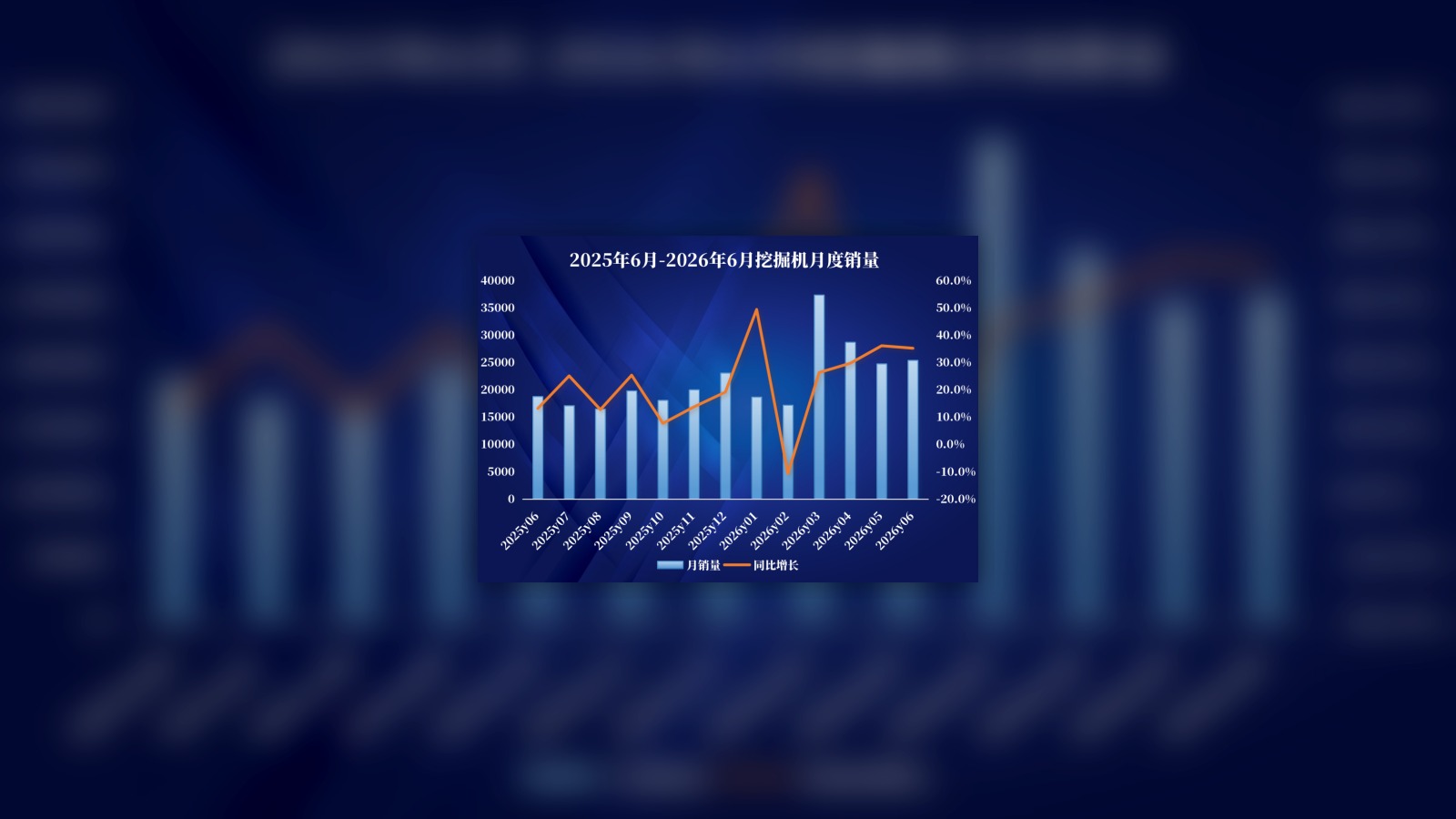
According to figures reported by 21-SUN from the China Construction Machinery Association, 25,445 excavators were sold in June 2026, up 35.3% year on year. First-half sales reached 152,320 units, a 26.4% increase. The headline is strong, but the detail is more useful for buyers, dealers, and export teams.
Export demand is carrying real weight
Exports reached 14,547 units in June, up 36.4% year on year and equal to 57.2% of monthly excavator sales. Domestic sales also improved, rising 33.9% to 10,898 units, but exports again took the larger share.
That split matters. A market led by both domestic replacement and overseas demand behaves differently from a short local rebound. Dealers need to watch shipping slots, regional inventory, and spare-parts support. Contractors need to ask whether a machine ordered for one market can be configured quickly for another. For manufacturers and suppliers, the lesson is simple: export readiness is now part of the basic product plan, not a separate sales project.
Mid-size and larger machines are getting attention
The product mix also says something about where work is happening. In June, domestic sales of large, medium, and small excavators rose 18%, 40%, and 35% respectively. Export sales grew 21%, 40%, and 43% across the same size groups.
Small excavators still have plenty of work in utilities, landscaping, municipal repair, and rental fleets. North American trade coverage continues to point to compact excavators as one of earthmoving's most active categories, helped by transportability and attachment use. But the strong growth in medium and large excavators suggests that quarrying, mining, large infrastructure, and heavy civil projects are also pulling demand.
For a buyer, this is where the decision becomes less about tonnage and more about use. A larger crawler excavator can cut cycle time on bulk earthmoving, but only if the jobsite, trucks, operator skill, and fuel budget match the machine. A mini excavator can be the better business case when the work is scattered across tight sites and the machine needs to move often.
Replacement demand is no longer a side note
The previous sales peak from 2019 to 2022 is now moving into the replacement window. Many machines bought during that cycle are reaching the age where maintenance cost, downtime risk, emissions rules, and resale value become boardroom topics rather than workshop complaints.
That does not mean every owner should replace early. It does mean the calculation should be written down. Compare repair spend, availability, fuel use, attachment needs, financing cost, and resale timing. If a machine is critical to production, one unplanned failure during peak season can erase the savings from delaying replacement.
Electric excavators are still tiny, but worth tracking
Electric excavators remain a small part of the market. The June total was 99 units, and first-half sales reached 321 units. Penetration was still around 0.21%, although that is up from 0.04% in 2024 and 0.12% in 2025.
That is not mass adoption yet. For most earthmoving fleets, diesel remains the default because duty cycles, charging access, purchase price, and residual value still have to work. Electric models make more sense first in controlled sites: factories, tunnels, urban low-noise zones, ports, and projects with predictable shifts. The signal is not that everyone should buy electric excavators immediately. The signal is that spec sheets, charging plans, and total-cost assumptions need to be monitored now, before bids start asking for them.
What equipment buyers should ask before the next purchase
- Which jobs will keep this excavator busy for at least the next two years?
- Is the machine mainly replacing an older unit, adding capacity, or opening a new type of work?
- Will the excavator need export-market configuration, local compliance changes, or different attachments later?
- Are parts, service response, hydraulic attachments, and operator training ready before delivery?
- Would a smaller machine with better mobility earn more than a larger machine with lower use?
The takeaway for earthmoving fleets
The June numbers make one thing clear: excavator demand is broadening, not just bouncing. Exports are strong, domestic work is improving, medium and large machines are moving again, and electric excavators are slowly becoming part of the conversation.
For XeMach, the practical takeaway is to treat excavator selection as a jobsite economics question. Match the machine to the work, check the support plan, and do not buy only because the market is hot. A good excavator purchase should still make sense after the cycle cools.
Sources: 21-SUN; Construction Equipment.