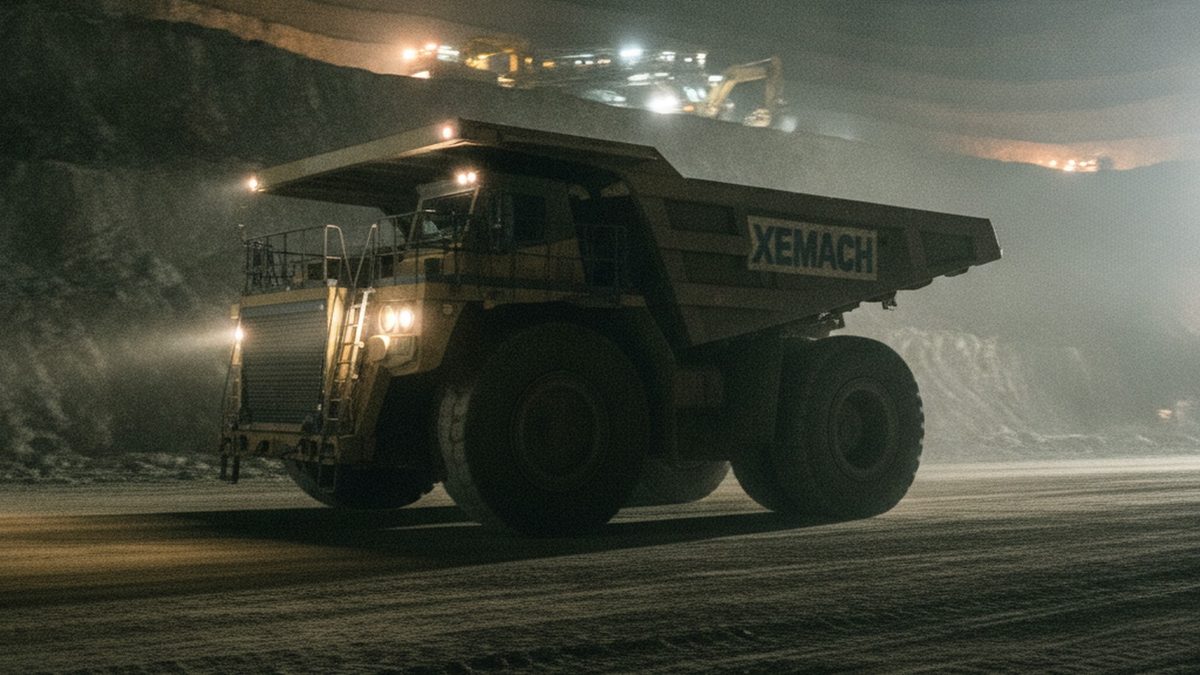
A mine planner watching the morning shift change has a simple problem to solve: keep ore moving for 24 hours, on steep haul roads, with less diesel burn and fewer safety incidents. That problem is starting to reshape the dump truck business faster than many buyers expected.
Recent reports from CEhome, 21-SUN, and the China Construction Machinery Industry Association point to the same conclusion from different angles. One large batch of hybrid autonomous mining dump trucks is being deployed into a Xinjiang coal mine. Another batch of mining dump trucks has been delivered to a gold project in northern Peru. At the same time, association data shows the country’s construction machinery exports kept growing in May, with export value up 20.8% year over year and the January-May total also up 20.8%.
This does not mean the market has suddenly “solved” mining haulage. It does mean the conversation is shifting. Buyers are no longer looking only at payload, horsepower, and price. They are asking whether a truck platform can cut site energy use, stay reliable in extreme duty cycles, plug into autonomous dispatch, and travel well across export markets with different terrain and service expectations.
Why hybrid and range-extended haulage is getting real attention
The Xinjiang deployment is a useful signal because it combines two things miners usually evaluate separately: lower operating cost and lower exposure to driver-related risk. According to the report, the fleet uses hybrid power with a 400 kW flywheel range-extending system and L4 autonomous driving capability. The same report says the trucks were engineered for heavy loads, dust, and continuous round-the-clock operation, with overall energy consumption roughly 30% lower than a conventional diesel mining truck.
That figure matters less as a marketing line than as a purchasing clue. Mines do not switch platforms because a brochure promises a greener future. They move when the operating model starts to work on paper: lower fuel spend, longer maintenance intervals, and a control system that can keep trucks cycling without adding the same amount of labor. In remote mines, that mix is often more persuasive than a pure battery story, especially where charging infrastructure is still uneven.
Export growth is no longer just about shipping iron
The Peru delivery points to a second shift. Export success in mining trucks now depends on whether the machine package can match local conditions, not just whether it can be built at scale. High altitude, steep grades, dust, and continuous duty expose weak cooling, weak driveline calibration, and weak service planning very quickly.
That is why recent export wins deserve attention beyond the headline. They suggest that Chinese suppliers are being tested on complete jobsite fit: powertrain behavior, durability, after-sales response, and the ability to tailor machines for specific mines. For buyers, the question is changing from “Can this manufacturer ship a truck?” to “Can this supplier support a production system?”
The truck is becoming one node in a mine transport system
Autonomy pushes the market in the same direction. Once a mining dump truck is tied into vehicle-ground-cloud coordination, the unit sale becomes only part of the value. Loading rhythm, route planning, obstacle avoidance, dispatch logic, and maintenance visibility start to matter as much as the truck’s mechanical specification.
That has practical consequences for fleet selection. A mine that plans to scale autonomous haulage cannot treat software integration as an afterthought. It needs to ask how the truck communicates with dispatch, how it handles mixed fleets during transition, and what happens when the site wants to expand from a pilot zone to a full haul circuit. In other words, the buying decision is moving upstream, from iron alone to system architecture.
What buyers should audit before scaling a new dump truck fleet
- Check the duty cycle first. A truck that looks efficient on a simple fuel sheet may behave very differently on long grades, stop-start loading, or high-altitude haul roads.
- Treat energy strategy as a site decision, not a truck option. Hybrid, range-extended, and electric routes each depend on different infrastructure and maintenance habits.
- Ask for the autonomy roadmap in plain language. “Ready for autonomy” can mean many things; buyers need to know what is available today and what still depends on future deployment.
- Pressure-test service coverage. Export deliveries sound impressive, but uptime in a remote mine still comes down to parts, field support, and response time.
What this means for the next buying cycle
The recent news flow suggests mining dump trucks are moving into a more demanding phase of competition. The machines that stand out will not be the ones with the loudest product launch. They will be the ones that can survive punishing mine conditions while lowering energy use, fitting autonomous workflows, and holding up in export service networks.
For XeMach, the practical takeaway is straightforward: customers in mining transport are buying fewer isolated machines and more operating logic. Any supplier that wants to stay relevant in this segment has to think like a fleet partner from day one.
Sources consulted: CEhome, 21-SUN, and China Construction Machinery Industry Association data published on June 22, 2026.