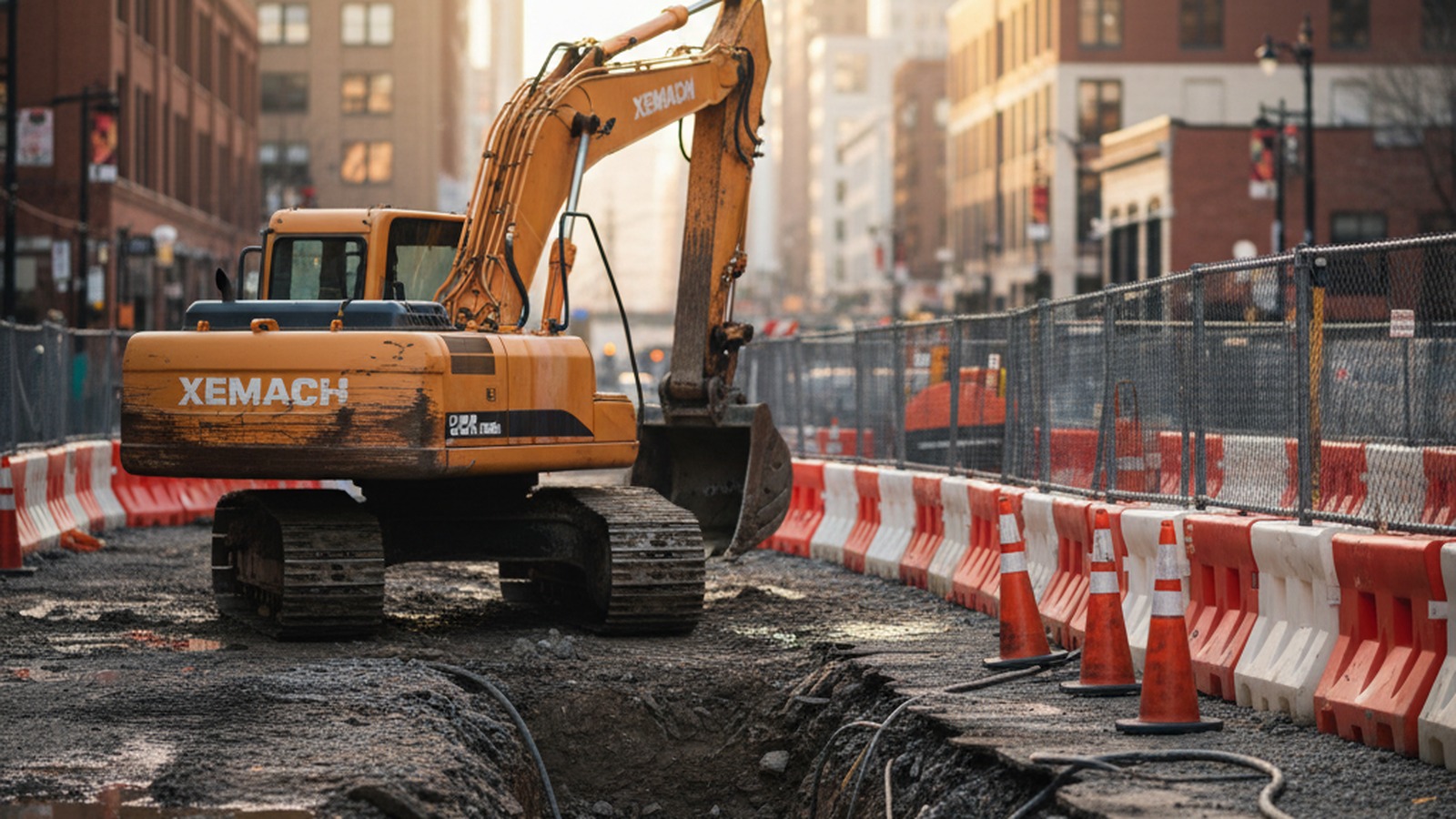
A utility crew is opening a trench along a crowded city street. Traffic barriers are tight, the dig line runs close to buried services, and the operator has only seconds to react when a person steps into the machine's blind side. In that kind of job, a standard rear-view camera is not enough.
The market is shifting from visibility to intervention
The latest excavator safety technology is no longer just about giving operators another screen to watch. The more important change is that machines are starting to interpret risk and react before a mistake becomes a strike, a collision, or a costly shutdown.
Recent industry coverage points in the same direction. Construction Equipment reported that AI camera systems on off-highway machines are moving past passive recording and into real-time detection, spoken warnings, incident review, and telematics-linked event data. Equipment World then showed the trend becoming more concrete for excavators: RodRadar and Hexagon introduced a system that combines bucket-mounted ground-penetrating radar with hydraulic intervention, so the machine can stop automatically when it approaches a buried utility. Another Equipment World demonstration highlighted how autonomous and assisted excavator systems are combining cameras, GPS, digital terrain views, and people-detection tools in a single operating workflow.
That combination matters. For years, fleets bought safety add-ons one piece at a time: a camera here, a monitor there, maybe a warning buzzer if the budget allowed. What is emerging now is a more connected stack where sensing, machine control, and operator guidance work together.
Why this matters most on excavators
Excavators sit at the center of many of the industry's hardest near-miss problems. They work close to underground utilities, swing in confined spaces, load trucks under time pressure, and often operate with limited visibility to the side and rear. A warning-only system helps, but it still leaves the final outcome dependent on human reaction time in a noisy, distracting environment.
That is why intervention is becoming the next logical step. A machine that can detect a worker in a blind spot, recognize a no-dig boundary, or slow or stop bucket motion near a known hazard changes the risk profile in a more meaningful way than video recording alone.
The business case is also getting easier to explain. Equipment World cited more than 400,000 underground utility strikes reported annually in the United States. The same report said vacuum excavation trucks used for potholing can cost far more per month than a radar-based excavator rental setup. Even when contractors do not adopt full intervention packages, the direction is clear: better sensing is starting to compete on both safety and job cost.
What buyers should ask before choosing a safety package
Not every "smart" excavator system is equally useful in field conditions. Buyers should get past the brochure language and ask practical questions.
First, what does the system actually do when it detects risk? A camera that only records is one thing. A system that triggers a clear in-cab alert is better. A system that can limit swing, stop bucket travel, or enforce a depth boundary is in a different category entirely.
Second, how does it behave in mud, dust, glare, rain, and night work? Excavators do not operate in ideal lab conditions. Sensors that perform well in demos but create too many false alerts on real jobs will be switched off by crews.
Third, is the setup retrofit-friendly? Many fleets cannot replace excavators just to gain better safety features. Systems that can be installed across mixed fleets have a faster path to adoption.
Fourth, what data comes back to the fleet manager? Video clips, near-miss logs, operator coaching events, and machine-location context are far more valuable when they feed training and maintenance decisions instead of sitting unused.
Finally, how easy is override control? Operators still need authority in real work, but the override logic should be deliberate and traceable, not casual enough to defeat the whole point of the system.
The next step is not full autonomy for everyone
The industry is talking loudly about autonomous equipment, but most excavator buyers are not choosing between manual operation and a robot. The real near-term decision is whether to stay with passive awareness tools or move toward assisted systems that can shape machine behavior at the edge of a mistake.
That middle ground is where the most practical progress is happening. Digital grade views, people detection, underground-utility sensing, boundary controls, and selective hydraulic intervention do not remove the operator. They reduce the number of situations where a tired operator has to make a perfect decision in a split second.
What this trend means from XeMach's side of the table
From XeMach's standpoint, the interesting shift is not that excavators are becoming flashy tech platforms. It is that safety features are finally being judged by whether they hold up on real jobsites and whether they reduce avoidable downtime.
For buyers, the takeaway is simple: when evaluating the next excavator, ask less about how many cameras it has and more about how the machine senses risk, how quickly it responds, and how cleanly those tools fit daily trenching, loading, and urban utility work. That is where the next round of differentiation will be won.