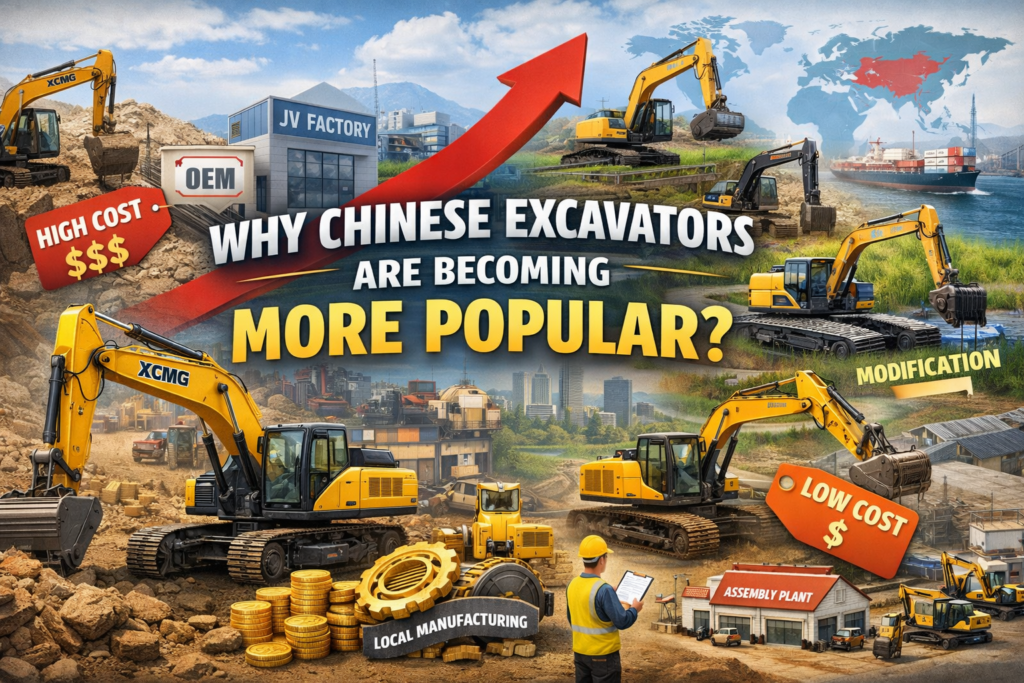
Over the past few years, a clear trend has emerged in the global construction industry: more contractors, fleet owners, and rental companies are switching from traditional “big-name” excavators to Chinese brands. You might recognize some of the leading names—like XCMG or SANY—but you may also see unfamiliar brands showing up on job sites and performing surprisingly well.
Then comes the moment that makes many buyers pause: the price. For similar tonnage and configurations, the quotation can be dramatically lower than expected.
So what’s really happening? The short answer is not “cheap labor,” and not “one magic brand.” The deeper reason is that China has built an unmatched ecosystem of market segmentation—a layered manufacturing structure that can produce everything from premium OEM machines to cost-optimized models, special-purpose conversions, and refurbished units for budget-sensitive markets.
Let’s break it down.
1) Market Segmentation: China’s “Hidden Advantage”
Excavators are not one-size-fits-all products. A 20-ton class machine can be purchased for completely different reasons:
- heavy-duty continuous work vs. light intermittent work
- mining or rock vs. soft soil and drainage
- rental fleet utilization vs. owner-operator usage
- maximum uptime vs. lowest upfront cost
- standard machines vs. specialized applications (railway, demolition, wetlands)
In mature markets, many buyers were historically pushed toward a limited set of premium options. In China, however, the industry evolved into multiple specialized layers, each targeting a different customer profile and price band. This is why Chinese excavators can feel like they “cover every possible budget.”
2) Foreign Brands in China: Scaling Back and Deep Localization
For decades, international brands sold huge volumes in China. Many also built factories, joint ventures, and local supply chains. But in recent years, the strategy of many foreign brands has shifted:
- scaling back manufacturing footprints
- consolidating or merging operations
- increasing reliance on local supply chains
- focusing on fewer high-margin products
As a result, an uncomfortable truth is becoming more common in some product categories: manufacturing and supply chains can become deeply localized, while the brand price premium remains high.
From a buyer’s perspective, that creates a natural question:
“If the supply chain and manufacturing are closer than we think, how much extra am I paying purely for the label?”
That question is one of the drivers behind the growing popularity of Chinese alternatives.
3) JV (Joint Venture) Factories: Technology Transfer + Local Manufacturing Maturity
Another major factor is the joint venture history.
When Western brands entered China, a common model was:
- Chinese partners provided production capability, workforce, and local market access
- foreign partners contributed technology, processes, and product standards
- both sides captured market share together
Over time, many JV structures changed or split. But one thing remained:
manufacturing know-how, engineering skills, and supply chain capability stayed in the market.
That created a huge mid-tier space where products became:
- mature and reliable
- closer in performance than many people expected
- significantly more affordable
This is a core reason why many buyers now say:
“The value gap is getting too big to ignore.”
4) Major Chinese OEMs: Integrated Strength (R&D + Production + Service)
The strongest Chinese manufacturers are no longer “simple assemblers.” Many have built integrated systems comparable to global leaders:
- R&D and product iteration: faster model updates and wide coverage
- modern production systems: improving quality consistency and capacity
- sales and after-sales networks: parts supply and service training
- diverse product lines: earthmoving, road machinery, material handling, mining equipment
A key competitive point is internal manufacturing depth. Many major OEMs produce a significant portion of their own structural components and parts, with high “in-house” rates. Even when engines and major hydraulic components are sourced externally, the OEM’s control over core structure, process, and assembly still improves consistency and cost efficiency at scale.
This integrated capability is why top Chinese brands increasingly win bids not just on price, but on availability, delivery speed, configuration flexibility, and total cost of ownership.
5) Assembly Plants: Small, Flexible, and Fast to Respond
China also has a layer of assembly-focused factories. These operations typically:
- build only one or two product categories
- source most components externally
- focus on rapid assembly and fast delivery
- shift quickly when market demand changes
They may produce machines that “look similar” to popular models, but their value proposition is different:
- fast supply
- lower upfront costs
- flexible production planning
This layer serves markets where:
- demand fluctuates sharply
- customers want acceptable performance at the lowest investment
- buyers prioritize quick delivery and basic usability
It’s part of the reason Chinese supply can feel “endless” and highly responsive.
6) Modification Factories: Customized Machines for Special Jobs
Beyond standard excavators, China has a strong ecosystem of modification workshops. Two common categories stand out:
A) New Machine Customization
Examples include:
- long-reach conversions
- demolition configurations
- amphibious/wetland excavators
- railway-use adaptations
- special attachment integration (grapples, breakers, dredging tools)
For customers in niche environments, customization is often the difference between “a machine that works” and “a machine that earns.”
B) Refurbishment of Used Equipment
China also has a large refurbishing sector where used machines are rebuilt:
- replacing worn parts
- overhauling powertrains
- updating undercarriage components
- repainting and reconditioning appearance
For budget-sensitive buyers, refurbished equipment provides a “second-life” option at a much lower price point—especially in markets where maintenance capability is available locally.
7) The Conclusion: Two Big Reasons Behind the Rise
If we summarize everything into two key drivers:
1) Thirty Years of Volume Built Real Capability
Foreign brands sold countless machines in China over decades. In doing so, they also helped shape:
- engineering standards
- production processes
- quality control methods
- supplier ecosystems
- workforce skills
That long period of market exposure accelerated local industrial maturity.
2) China’s Massive Market Created Multiple “Survival Zones”
China’s construction and infrastructure demand has been enormous. In such a competitive environment, thousands of companies found ways to survive by specializing in different segments:
- premium OEM
- value mainstream
- fast assembly supply
- customization
- refurbishment
This segmentation is the real engine behind China’s competitive advantage.
What This Means for Global Buyers
Chinese excavators are becoming more popular not because “everything is cheap,” but because buyers can now match their exact needs and budget with a more precise option.
To make a smart decision, buyers should compare more than the sticker price. The best approach is to evaluate:
- job type and working conditions
- uptime expectations and duty cycle
- parts availability and lead time
- after-sales response capability
- warranty scope and service training
- total cost of ownership (TCO), not just purchase cost
What Would You Like to Learn Next?
We can go deeper into practical topics such as:
- How to choose between top-tier Chinese OEMs vs. value brands
- How to verify real configurations (engine/hydraulics/steel) before shipment
- A pre-shipment inspection checklist and arrival acceptance checklist
- How to calculate TCO simply for excavator purchasing decisions
- Common pitfalls in exporting excavators to Africa, the Middle East, and South America
Leave your questions—and tell us your target tonnage and country/region. We’ll tailor the next article to your real use case.