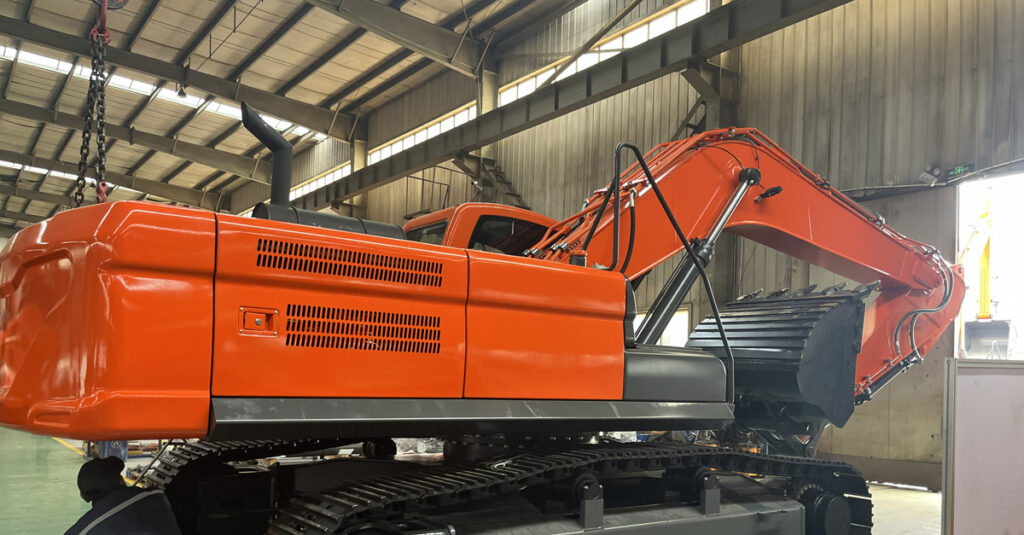
More and more overseas friends prefer Chinese construction machinery. “Cheap and good” has become the second name for “Made in China.” Do you know the reasons behind this? And do you know why Chinese equipment is always cheaper than Caterpillar and Komatsu?
Today, let’s take a look at the reasons behind this.
First, let’s look at production capacity. China’s current production capacity has achieved industrial clustering. Take hydraulic breakers for example. In Summer’s hometown, there are hundreds of hydraulic breaker factories. In fact, you could set up a factory to produce hydraulic breakers in China within a month. Why? Because all the components can be sourced within a 300-kilometer radius. Raw materials, high-precision machine tools, heat treatment processing plants, and even experienced production line workers are all readily available. So, against such a favorable backdrop, production is not difficult.
Next, let’s look at price. Because the raw materials and processes required for production are relatively accessible, the price naturally isn’t very high. As a customer, your task is to find the supplier that truly suits you.
Let’s talk about the price. Everyone knows you get what you pay for. Heavy equipment like construction machinery is essentially built from materials. If the equipment you buy is much cheaper than others in the industry, it means the materials used aren’t as good. There’s no such thing – you can’t buy a high-quality product at a low price.
This answers the first question: Why is it cheap and good? Because the industry is mature and competition is fierce.
Now, let’s look at why prices can’t compete with Caterpillar and Komatsu?
Actually, there are two reasons. One is product details and material quality. If you used the same materials as Caterpillar, it would be easy to find such raw materials in China, but the production cost might reach 80% of Caterpillar’s price. Then the problem arises: customers are unwilling to pay just 20% less for a Chinese brand; they’d rather spend a bit more and buy Caterpillar. So, the only option left is the second method: make the price even cheaper, maybe 50% of Caterpillar’s price or lower. To do that, you have to compromise slightly on materials and processes. This makes it easier for the market to accept, and this is the approach in the current mainstream market. It’s like BYD – even if their top model had all the same features as a Tesla, you probably wouldn’t want to pay 80% of a Tesla’s price for it; you’d just buy the Tesla directly.
So, the market has now reached a relative balance. “Made in China” means cheap and good. If the price is a bit higher, people are reluctant to accept it. However, Chinese manufacturers have found their place in this market dynamic. Customers can get cost-effective products for a better price, and manufacturers can keep running by maintaining low profit margins.
What else do you want to know? Tell Summer in the comments, and let’s discuss it together!