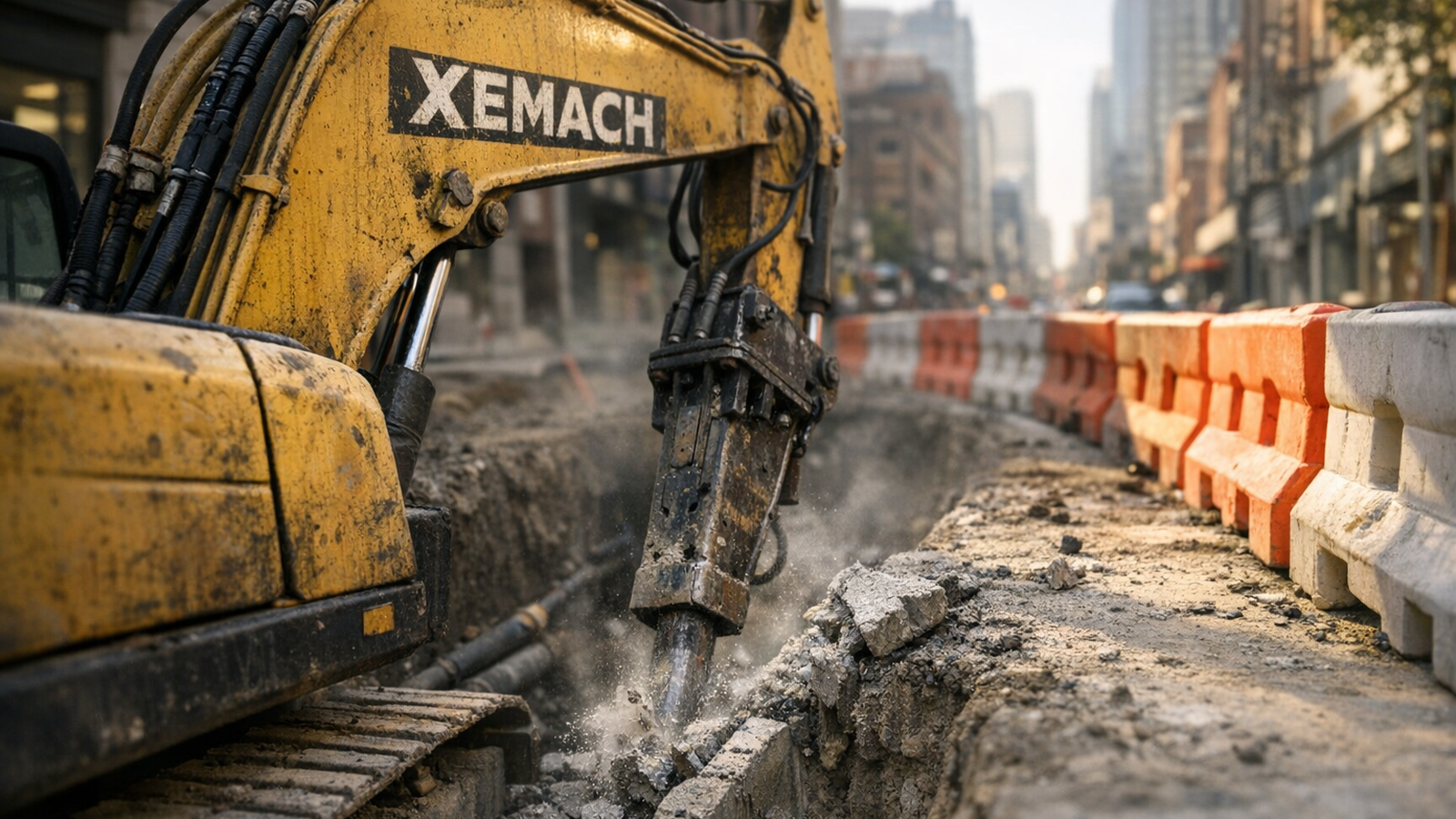
Stop Treating Hydraulic Breakers Like “Just Another Attachment”
Hydraulic breakers (hydraulic hammers) can turn an excavator into a demolition or rock-breaking specialist in minutes. They can also turn a healthy carrier into an overheating, bushing-eating headache just as fast.
What is changing in 2026 is not the basic physics of impact. It is the industry’s growing focus on three things: correct carrier matching, maintenance that actually happens on site, and breaker features that help operators avoid common mistakes.
From a XeMach perspective, the most useful shift is simple: fleets are starting to spec breakers with the same rigor they apply to the base machine. That is good for uptime, tool life, and resale value. It is also where many projects quietly win or lose money.
1) Spec the breaker to the excavator, not the jobsite rumor
A breaker is only as good as the hydraulic system feeding it. The most common failure pattern we see is not “bad steel.” It is a mismatch.
- Too much flow or pressure: the breaker can cycle too fast, heat the oil, and accelerate seal wear.
- Too little flow: impact energy drops, production slows, and the tool tip can suffer because the piston timing is off.
- Size and stability mismatch: an oversized breaker on a light carrier increases stress through the boom and coupler; an undersized breaker on a heavy carrier wastes hours.
A practical rule many fleets use is to avoid sizing a breaker to the excavator’s combined pump output. Instead, treat one-pump flow as the ceiling unless the breaker and carrier are designed for higher combined flow.
XeMach view: start with numbers, not brand names. Know usable flow, pressure, and backpressure limits. Then choose a breaker that lives comfortably inside that envelope.
2) The “boring” checks are where breaker ROI lives
Breakers fail in predictable ways. The good news is that many failures are preventable if the fleet treats breaker care as routine work, not a rescue mission.
Habits that consistently pay back:
- Lubrication discipline: many breakers need greasing every 1 to 2 hours. In harsh dust, heat, or cold, intervals can shrink to 30 to 60 minutes. The right high-temperature chisel paste tends to stay put better than general-purpose grease.
- Wear-part inspection: bushings, tool shanks, and retainers show early warning signs when fit is drifting or lubrication is being missed.
- Hydraulic cleanliness: dirty oil and neglected filtration turn normal operation into abrasive wear.
- Avoid blank firing: striking without proper tool contact wastes energy and speeds up internal wear.
This is where people-first maintenance matters. A perfect checklist is useless if it lives in a spreadsheet no one opens. The fleets that improve uptime make these tasks easy to do, easy to record, and hard to forget.
XeMach view: a breaker program succeeds when the workflow fits real jobsite behavior, not when it looks good in a policy document.
3) Where breaker technology is heading
Breaker designs are adding features aimed at making performance more consistent and reducing operator sensitivity:
- Auto-lube options and better sealing to cut missed intervals and contamination.
- Output control that adjusts energy to material resistance.
- Noise and vibration suppression that expands where breaking can happen, especially in urban work.
- Sensors that track operating hours, strike frequency, and maintenance needs.
None of this replaces correct matching. But it can reduce the damage caused by “close enough” setups and rushed operators.
XeMach view: the best features make the machine harder to misuse without adding complexity.
4) The overlooked interface: couplers, geometry, and how the force travels
In breaker work, the attachment is not only connected hydraulically. It is connected structurally. Coupler choice, pin fit, boom geometry, and the carrier’s lift curve influence stability and how shock loads transfer.
If a breaker setup feels harsh, bouncy, or unusually hot, the root cause may be upstream: carrier balance, coupler fit, hydraulic settings, or worn bushings.
XeMach view: breaker performance is a system. Carrier, coupler, hydraulics, and maintenance all have to agree.
Conclusion
Hydraulic breakers will always be hard on equipment. That is the job.
But fleets are getting better at separating normal wear from avoidable wear. The projects that win are the ones that spec the breaker with real hydraulic numbers, build maintenance into daily routines, and choose features that reduce operator mistakes.
If you are planning your next breaker purchase or standardizing attachments across a mixed fleet, start with the carrier envelope and the workflow. The steel can only do what the system allows.