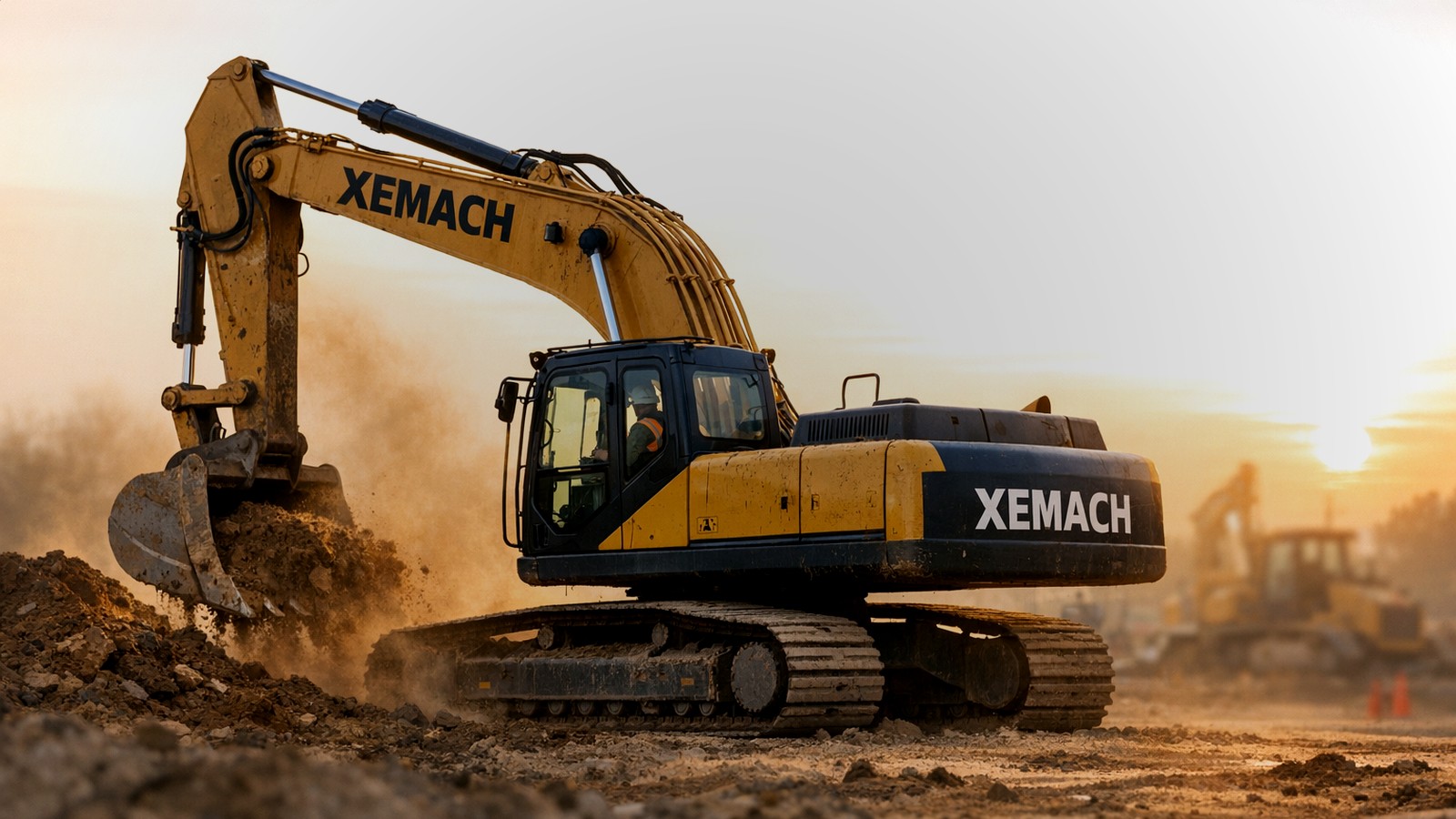
Excavators are quietly changing. The headline features at major industry events aren’t just bigger buckets or higher breakout force — they’re software layers that reshape how a crawler excavator feels in the cab, how safely it works around people, and how easily a fleet team can keep it productive.
Across new mid-to-large crawler excavators and the digital platforms behind them, three threads are converging: fully electrohydraulic (FEH) controls, camera-based AI safety functions, and “decision-ready” fleet data. Together, they are pushing excavators toward a software-defined future — where performance upgrades increasingly arrive as calibrations, sensors, and workflows, not only as iron.
1) FEH controls: more precision, less fatigue, more consistent cycle times
FEH control architectures replace older pilot-hydraulic behavior with electronically managed valves and pumps. In practical terms, that matters because an excavator’s productivity is often won in the small moments: grading smoothness, feathering a breaker, holding a lifting line steady, or repeating the same truck-loading cycle for hours.
From a contractor’s perspective, FEH can deliver:
- More repeatable response across operators and ambient conditions (less “mystery feel”).
- Better mode tuning for lifting, eco work, high-cycle loading, and fine grading.
- Faster attachment integration when paired with in-cab attachment flow presets and electrohydraulic calibration.
XeMach view: FEH is becoming the “operating system” of the excavator. Once controls are digital, OEMs can ship better controllability and efficiency through software refinement — and fleets can standardize operator experience across mixed job types.
2) AI safety is moving from optional to expected
Excavator work is increasingly done in tighter spaces: urban renewal, utilities, roadwork and demolition. That density makes near-miss prevention a daily operational need. The recent wave of 270°–360° camera coverage and AI-based detection aims to reduce blind-spot risk and improve situational awareness.
However, the real value is not “another camera.” It’s the behavioral loop created by warnings, boundary alerts, and (in some cases) machine slow/stop logic. When these systems are calibrated well, they reduce the cognitive load on operators without creating alarm fatigue.
XeMach view: Safety tech wins when it is configurable (site rules differ), explainable (operators trust it), and maintainable (camera cleanliness, calibration routines, and uptime). Expect procurement checklists to start treating AI visibility and boundary functions as baseline requirements — especially for fleets working in public-facing or utility environments.
3) Fleet intelligence: from dashboards to decisions
Telematics has already proven it can answer what happened. The next step is helping teams decide what to do next — automatically prioritizing maintenance actions, highlighting root-cause patterns, and reducing the time spent jumping between fault codes and disconnected dashboards.
Data partnerships and “AI assist” tools are trying to solve a practical problem: fleet managers have plenty of data but not enough time. The winners will be the systems that turn signals into timely, actionable recommendations, such as:
- which excavators are trending toward hydraulic overheating, and what operating conditions correlate;
- which attachments drive the highest fuel burn per cubic meter moved, by job type;
- which operators or sites need targeted training based on repeatable patterns.
XeMach view: The most valuable “AI” in a fleet won’t be flashy autonomy first — it will be boring, reliable decision support that protects uptime and reduces total cost of ownership. Contractors should demand integration and open data pathways so they can avoid being locked into a single dashboard forever.
What this means for buyers of crawler excavators in 2026
- Evaluate the control stack (FEH, modes, attachment presets) as carefully as the spec sheet.
- Test safety features in realistic conditions (dust, backlight, clutter) to avoid surprise limitations.
- Ask how data becomes action: alerts, workflows, and who owns the data when the fleet changes.
Excavators will always be about steel and hydraulics — but the competitive edge is shifting. The best-performing fleets will be the ones that treat excavators as connected production assets, not isolated machines.