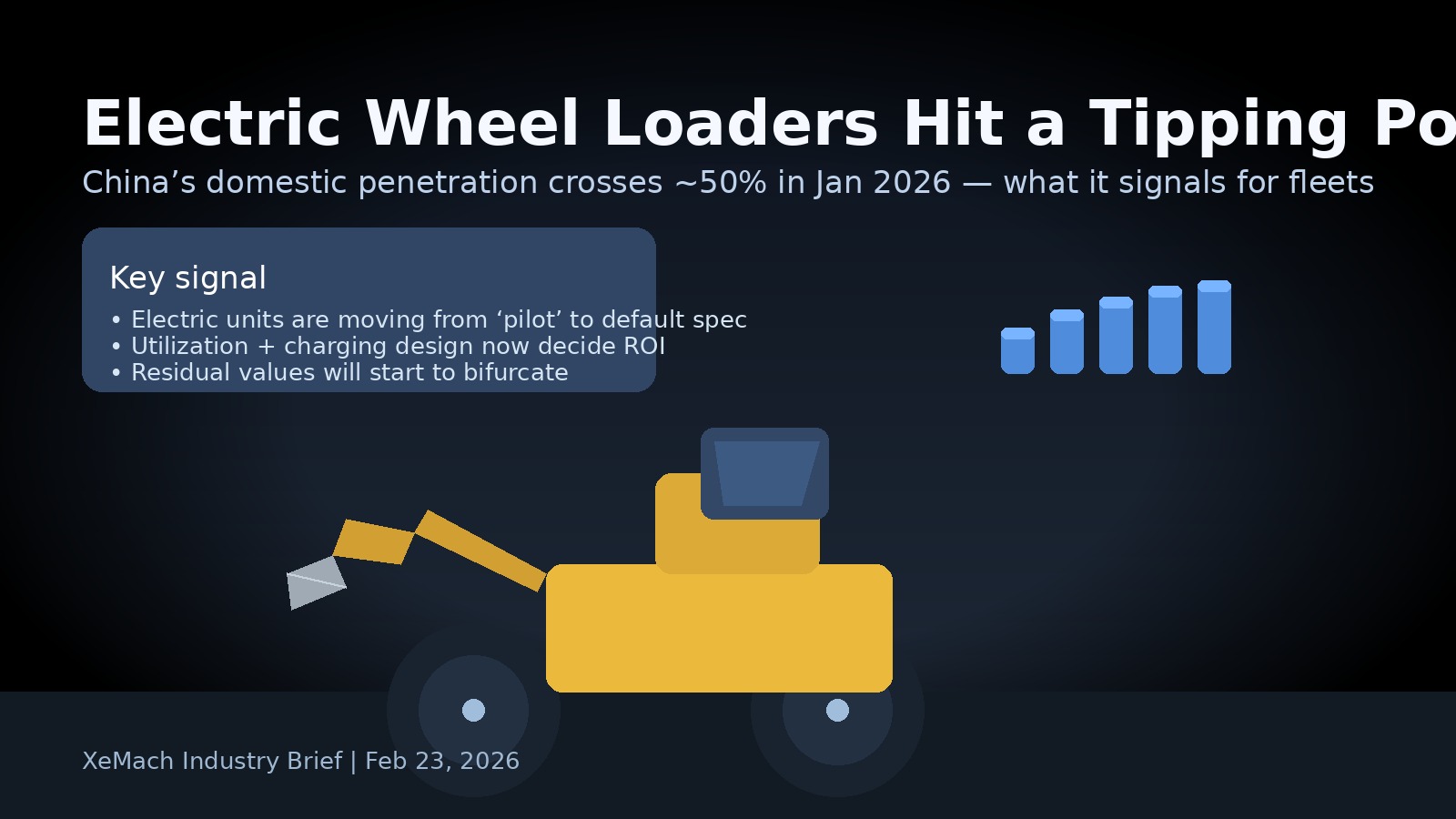
January’s loader market data in China sent a clear signal: electric wheel loaders are no longer a niche add‑on. Domestic penetration has moved past the psychological 50% threshold, with overall wheel‑loader demand also showing strong momentum. For contractors and fleet owners, that matters less as a headline and more as a practical warning: planning assumptions built around “slow adoption” are about to break.
What the numbers are really telling us
When a powertrain shift reaches majority share, the market stops asking if and starts debating how fast and where next. Three underlying messages stand out:
- Utilization is high enough to justify infrastructure. Charging (and power‑supply upgrades) only becomes rational when machines are running enough hours in predictable locations.
- Operator acceptance has improved. The jump from pilot projects to repeat purchases usually tracks comfort with performance, noise, and work‑cycle consistency.
- OEM and dealer systems are maturing. Parts, diagnostics, and service processes tend to lag early deployments; majority adoption implies those systems are catching up.
Why electrification is accelerating in the wheel‑loader segment
Wheel loaders are an especially “electrifiable” category because their duty cycles often involve repetitive load‑and‑carry work in fixed yards, ports, aggregate plants, and municipal depots. Those sites are also where electrification creates visible operational advantages:
- Energy cost stability: Electricity pricing is typically less volatile than diesel, which makes monthly operating cost forecasts more reliable.
- Maintenance simplification: Fewer engine‑related maintenance events can translate into more predictable uptime—if electronics and cooling systems are managed well.
- Workplace constraints: Noise and emission limits are tightening in urban and indoor‑adjacent operations, and loaders are frequently the first targets.
The fleet reality check: ROI is now decided by design choices, not the sticker price
As electrics scale, the competitive edge shifts from “buying electric” to “deploying electric correctly.” From XeMach’s viewpoint, the fleets winning on cost and uptime are doing three things:
- Right‑sizing battery and charger power to the actual cycle (avoid both under‑spec downtime and over‑spec capital waste).
- Building charging into dispatch planning (charging windows, route assignment, and shift patterns—not ad‑hoc plugging in).
- Tracking health and degradation with clear KPIs (kWh/ton, idle time, temperature events, and fast‑charge frequency).
What changes next: residual values and mixed fleets
Once electric becomes the default in a segment, resale markets start to bifurcate. Buyers will reward machines with transparent battery history and predictable remaining useful life, while older diesel units may see more volatile pricing depending on jobsite access rules and fuel costs.
For mixed fleets, the near‑term smart move is rarely “replace everything.” It’s usually to electrify the most predictable, high‑utilization sites first, then scale outward as infrastructure and processes become repeatable.
Bottom line
Crossing 50% penetration is a milestone because it changes procurement behavior across the entire ecosystem—from contractors to rental houses, from service partners to grid planners. The question for fleets in 2026 isn’t whether electric wheel loaders will work; it’s whether your operating model is ready to capture the upside without sacrificing uptime.