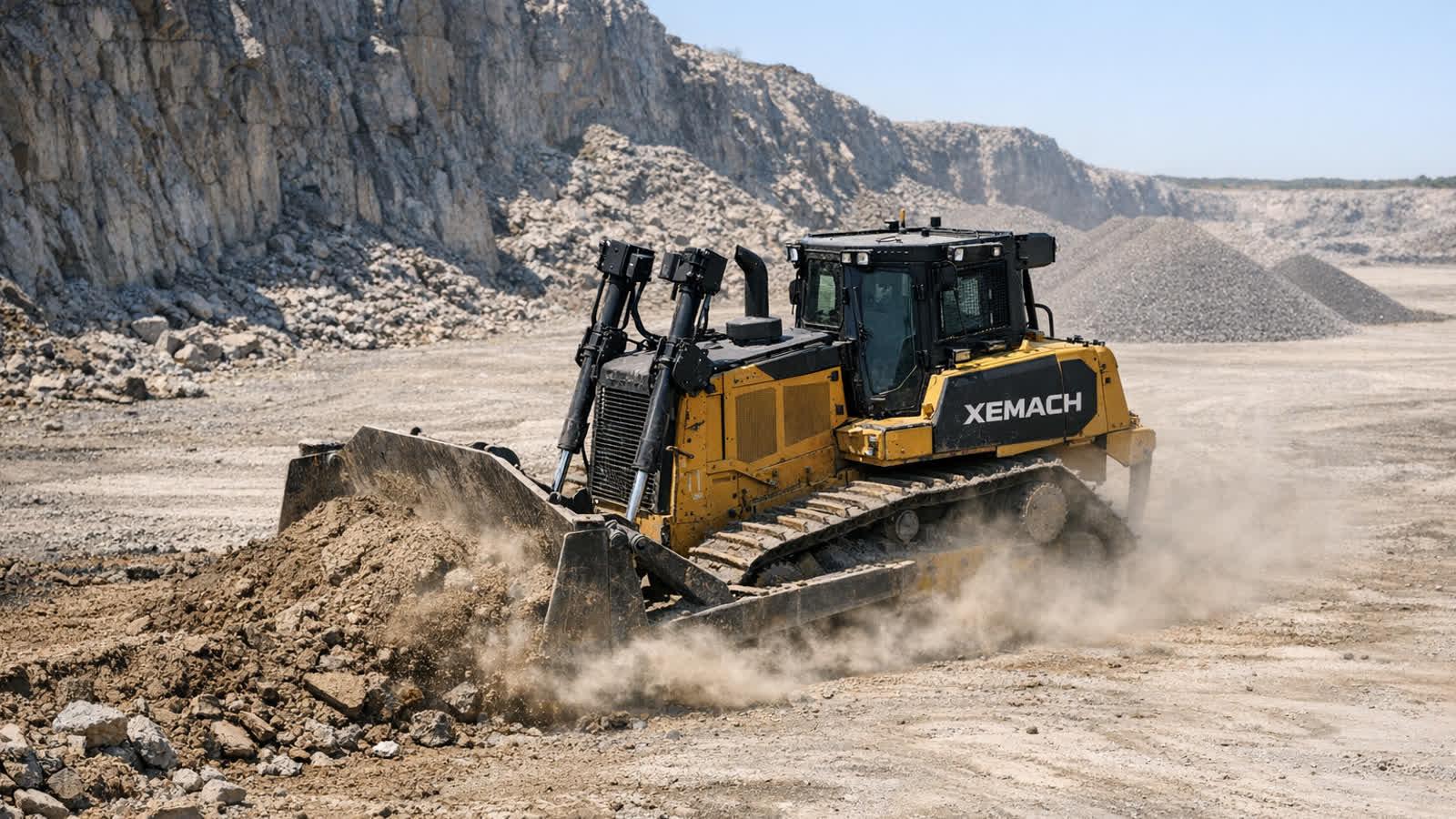
A medium dozer used to be a simple equation: diesel engine, powershift transmission, torque converter, and a lot of fuel turned into forward progress. That formula is not disappearing overnight. But the next generation is clearly being rewritten.
Electric-drive (diesel-electric) powertrains are showing up in mainstream dozer classes, not as a booth-only prototype, but as production-intent packages aimed at real earthmoving work.
Today’s signal is the push of electric drive into the D8 class. The headline is not “dozers are going fully battery.” It is that OEMs are using electrified drivetrains to deliver measurable efficiency, steadier push power, and simpler service access in machines that still need long runtimes and predictable uptime.
What “electric drive” means in a diesel dozer
In a conventional drivetrain, engine power flows through a torque converter and transmission, then down to the final drives. In an electric-drive layout, the engine turns a generator. That electrical output is conditioned and sent to a traction motor system that drives the machine.
From the operator’s seat, it still feels like a dozer. From a fleet manager’s view, it is a different way to manage torque delivery, heat, wear items, and rebuild cycles.
Why this matters in the D8 class
Electric drive has proved itself in larger mining machines for years, but the D8-size segment is where volume and jobsite variety make or break a technology.
In road construction, site prep, quarry work, overburden removal, landfill work, and reclamation, a dozer sees a lot of “medium-load” time. That is exactly where electric-drive systems tend to deliver their best efficiency gains. Typical claims in the market include:
- Lower fuel consumption (often cited around the ~10% range in the right duty cycle)
- More consistent torque to the ground, which can improve speed under load and cycle productivity
- Fewer mechanical transmission components that commonly drive rebuild cost and downtime
The deeper point: electrification is being used as a productivity tool, not just an emissions headline.
Serviceability is becoming a buying decision
Contractors rarely choose a machine because it sounds clever. They choose it because it keeps working.
A key reason electrified drivetrains are gaining traction is that the “complexity” is shifting. There may be more power electronics, but there are fewer traditional transmission wear components. Just as importantly, leading designs are being packaged to keep rebuild workflows familiar: pull-out modules, rails, and access patterns that resemble current service routines.
For fleets, that means electrification can be introduced without rewriting the entire maintenance playbook.
Heat management is the quiet enabler
Diesel-electric systems live and die by thermal control. Power electronics want very different temperatures than an engine coolant loop.
What matters on real jobsites is how the machine manages heat in hot, dusty, stop-and-go dozing where cooling capacity gets tested. Separate cooling circuits optimized for engine needs versus inverter/motor electronics are becoming a key reliability lever.
The technology stack is bundling fast
Dozer updates are not only about the drivetrain anymore. OEMs are packaging the powertrain with:
- Traction / slip management to reduce track wear
- Load monitoring and operator guidance
- Grade-ready paths for 3D upgrades
- Camera systems and object detection to reduce backing incidents
- Remote diagnostics and over-the-air software updates
This is not accidental. Electric-drive systems already rely on software for power management. Once software is in the loop, it is natural to add more operator-assist and fleet connectivity features around it.
XeMach perspective: what to check before you commit
Electric-drive dozers can be a strong fit, but contractors should pressure-test the match to their work.
-
Duty cycle fit
The best gains typically come in repetitive, medium-load pushing, not extreme, continuous high-load ripping. Ask for fuel and production data tied to jobs that look like yours. -
Thermal margin
In your climate and dust conditions, what is the cooling strategy, and how is it protected? Cooling is reliability. -
Service pathway
What does a generator/inverter/motor issue look like in the field? What are the swap times, and what dealer tooling is required? -
Operator adoption
Electric drive changes how a machine holds power under load. Plan a short training loop; small habits can unlock real gains. -
Tech package realism
Camera and assist systems are only valuable if they survive your site conditions and are supported long-term. Validate sensor placement, cleaning needs, and update policy.
Closing
The direction is clear: the dozer market is treating electrified drivetrains as a way to get more work done with less fuel and less drivetrain wear, not as a marketing experiment.
For contractors, the opportunity is to treat electric drive as a measurable business decision: uptime, rebuild intervals, and production per gallon. The next 12–24 months will be about proof in mixed jobsites, and identifying where the payback shows up fastest.