China’s wheel-loader market just delivered a signal that’s bigger than a single product cycle: electric models have moved from ‘pilot projects’ to ‘default choice’ in many domestic applications. January 2026 data indicates electric wheel loaders reached roughly half of China’s domestic wheel-loader sales, while overall loader volumes and exports also surged.
For equipment owners, rental fleets, and jobsite managers, this isn’t only about powertrains. It’s a shift in operating economics, service models, and how contractors plan uptime. From a XeMach perspective, the most important question is not “Will electrification happen?” but “How do we manage the transition without trading diesel complexity for battery complexity?”
1) The headline number—and why it matters
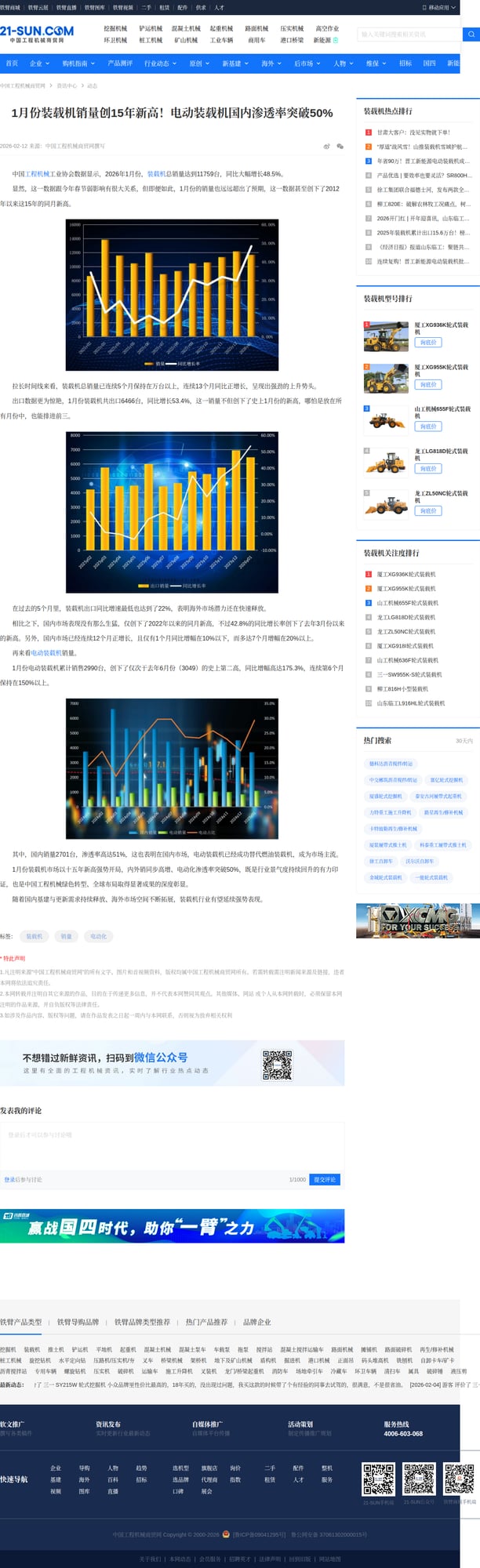
According to industry reporting based on association statistics, total wheel-loader sales in January 2026 were reported at 11,759 units, up 48.5% year-on-year. Exports were reported at 6,466 units, up 53.4% year-on-year. Within that, electric wheel-loader sales were reported at 2,990 units, up 175.3% year-on-year; domestic electric sales were reported at 2,701 units, implying around a 51% penetration rate in the domestic market.
Penetration above 50% is a psychological and operational tipping point. It changes:
- Bid assumptions (energy cost and carbon clauses become predictable enough to price in).
- Fleet planning (electric is no longer a niche slot; it becomes the baseline, with diesel reserved for edge cases).
- Resale logic (buyers start discounting diesel harder in certain segments; electric residuals stabilize when a second-hand ecosystem forms).
2) What’s driving the acceleration
Several forces appear to be stacking in the same direction:
Operating cost pressure (and the ‘energy arbitrage’ effect)
Wheel loaders are high-cycle machines. When electricity is reliably available—and priced favorably relative to diesel—contractors can convert fuel volatility into a more stable, managed cost. The bigger the fleet, the more this looks like a procurement strategy rather than a product preference.
Worksite constraints: noise, emissions, and compliance
Urban jobsites, enclosed facilities (ports, industrial yards), and projects with stricter environmental requirements reward electrification. Even where regulations are not the primary driver, customers increasingly treat low-noise and low-emission operation as a “must-have” for winning certain contracts.
Product maturity and the ‘good enough’ plateau
Early electric loader deployments were often framed as experiments. As products mature—battery thermal management, power electronics durability, regenerative strategies, and operator experience—electric machines stop feeling like “new tech” and start feeling like “the machine that does the job.” Once that perception flips, adoption can jump quickly.
3) The new bottleneck: infrastructure and uptime design
Electrification shifts the bottleneck from fueling logistics to charging logistics. And the operational penalty for getting charging wrong can be severe: a diesel loader can refuel in minutes; a poorly planned charging setup can quietly cut utilization for weeks.
From an asset-management standpoint, the winning fleets tend to treat charging as a system:
- Right-size charging power for the duty cycle (avoid both underpowered chargers and oversized capex).
- Staggered charging schedules to reduce peak demand and avoid queue time.
- Battery health strategy (temperature control, charging windows, and operator training) to protect long-term capacity.
- Fallback plans for power interruptions—especially on remote or temporary sites.
4) Service model shift: from mechanical-first to data-first
Diesel fleets have decades of maintenance muscle memory: filters, oil, injectors, aftertreatment, and periodic overhaul cycles. Electric fleets move some of that burden into:
- Battery diagnostics (state of health vs. state of charge, cell balancing behavior, thermal events).
- High-voltage safety and standardized procedures for technicians.
- Software and controls (firmware updates, fault-code triage, and sensor reliability).
This is where the next competitive gap opens. The OEM that can deliver not only a capable machine, but also predictable fleet-level uptime—through remote monitoring, parts availability, and field service readiness—wins the “second purchase.”
5) What to watch in 2026: adoption beyond the ‘easy’ use cases
Penetration can reach 50% first in the segments where electrification is naturally advantaged. The next phase is about expanding into harder duty cycles and less controlled environments. Three indicators worth tracking this year:
- Cold and hot climate performance (can fleets maintain utilization without excessive derating or battery stress?).
- Long-shift operations (multi-shift yards will need more sophisticated charging and rotation strategies).
- Export-market acceptance (as exports grow, buyers will test electric suitability against local grid conditions and service capacity).
XeMach take: electrification is now a fleet strategy, not a product feature
When electric wheel loaders exceed 50% penetration in a major market, the conversation changes. The question becomes: can contractors industrialize electrification—standardizing charging, training, maintenance workflows, and jobsite planning—so that electric machines deliver higher uptime and lower total cost, not simply “lower emissions”?
At XeMach, we believe the next wave of value will be built around deployment playbooks: the practical checklists that translate electric technology into reliable production. The fleets that master those playbooks will outcompete on both price and schedule.