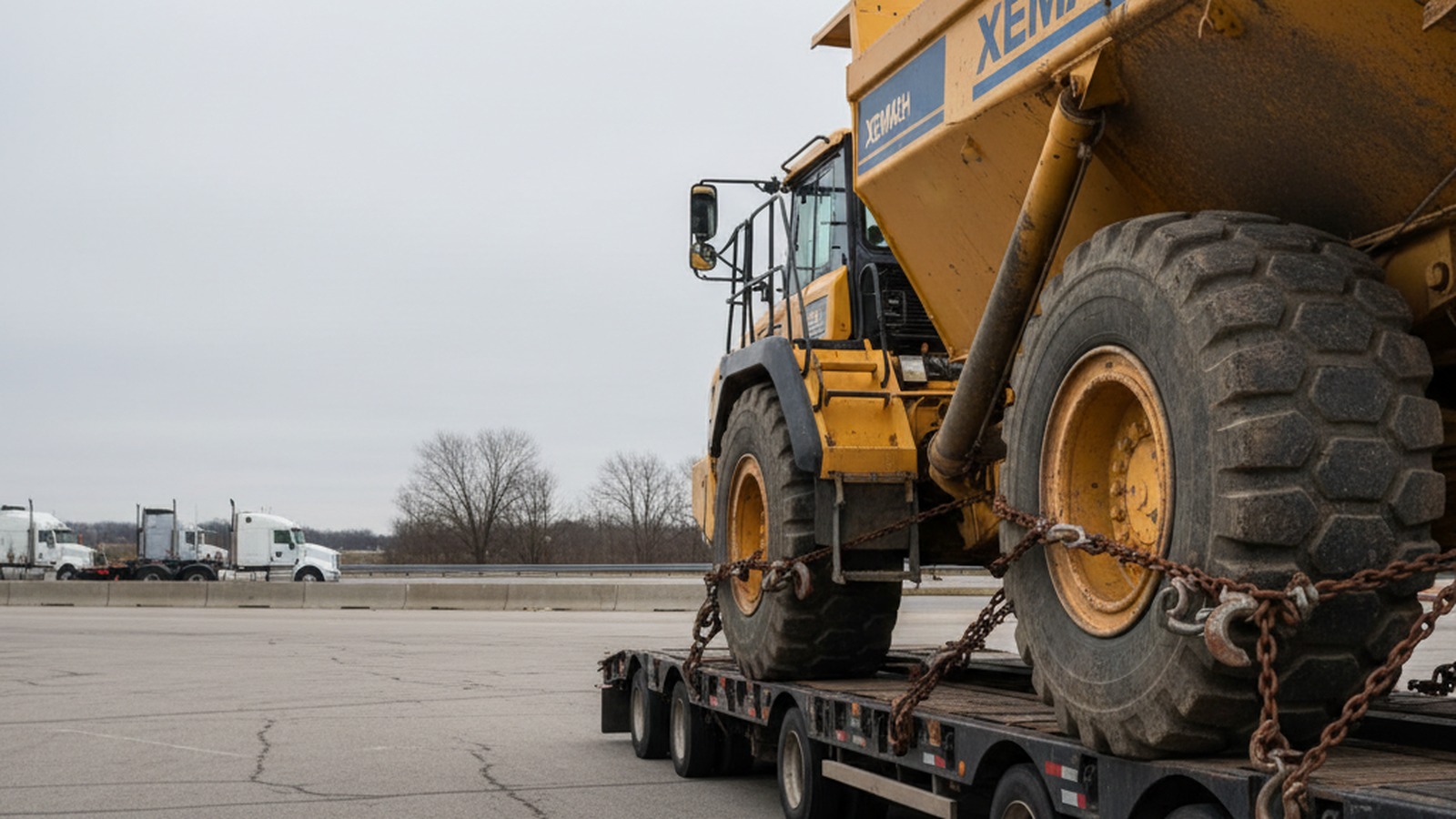
At 6:30 on a wet quarry morning, the excavator is ready, the haul road is already cut up, and one loaded truck starts to spin halfway up the ramp. The delay looks like a traction problem, but the real issue usually started much earlier: the truck was sized for brochure payload, not for the actual haul cycle, ground conditions, loading tool, and dump point.
That is why the articulated dump truck conversation is changing in 2026. Buyers are still looking at payload, of course, but more fleets are treating ADTs as part of a haul system rather than a standalone machine. Recent industry guidance collected by Construction Equipment points in the same direction: the best truck choice is often the one that creates the fewest compromises across loading, travel, dumping, tire life, and operator control.
Start with the haul system, not the headline spec
Payload still matters, but it is a poor shortcut for spec’ing an ADT. A truck that looks efficient on paper can lose time and money if it is mismatched to the excavator or wheel loader feeding it, or if the site is too tight, too soft, or too short-cycle for that class of machine.
A better starting point is the full movement of material. How long is the job? How far is the travel distance? Are you hauling over mud, blasted rock, steep grades, or maintained haul roads? Will the truck be loaded by an excavator, a wheel loader, or both across different projects?
Pass matching is where a lot of hidden waste shows up. If the loading tool needs too many passes to fill the truck, cycle time stretches and fuel burn climbs. If the truck is too small for the loading tool, overfill becomes easy, and that drives spillage, tire stress, and long-term wear. In practice, buyers are moving toward combinations that keep loading smooth and predictable rather than chasing the biggest body they can transport.
Transport logistics also matter more than many first-time buyers expect. On short-duration jobs, a larger truck may look productive on site but lose its advantage once lowboy moves, permits, and machine availability are counted. The right answer is not always the biggest answer.
Why traction and braking technology now carry more weight
Older buying logic treated traction as something the operator would manage with experience. That is less true today. Newer ADTs are increasingly built around automatic differential lock engagement, predictive drive control, hill-hold functions, retarders, and integrated braking logic that steps in before wheelspin or downhill instability turns into lost time.
For buyers, this matters for two reasons. First, productivity on rough or slippery ground now depends as much on controlled power delivery as raw engine output. Second, safety systems are no longer separate from production. A truck that keeps speed under control on grades and stays more stable during dumping can keep moving when a poorly matched machine has to slow down or wait for better conditions.
Vision systems are part of that same shift. Rear cameras, wider multi-camera coverage, and object-detection alerts are becoming part of the real operating equation on crowded sites, especially where trucks back into loading zones or move around support crews. For many fleets, visibility is no longer a nice-to-have option; it is basic risk control.
Dump body choices can change the economics of the cycle
Dump body configuration is still undervalued in many purchase decisions. Yet it has a direct effect on productivity, carryback, material release, and stability.
Tailgates and side extensions can make sense when the priority is maximizing material retention or usable capacity. Liners matter when abrasive rock is chewing through the body. Bed heating helps in cold or sticky material conditions where carryback quietly steals payload and adds cleanup time. And for some applications, ejector bodies deserve a closer look because they unload without raising the body, which can help when overhead clearance is limited or when controlled placement matters more than a simple pile dump.
The key point is that body design should follow material behavior and dump conditions, not habit. A fleet that hauls wet clay, quarry rock, and general overburden with the same assumptions will usually pay for it somewhere else.
Tires, joints, and haul roads decide whether the spreadsheet was honest
Tire cost is one of the fastest ways for an ADT purchase model to fall apart. The wrong tire choice for the application, poor inflation discipline, bad haul roads, and routine overloading can erase the savings that justified the machine in the first place.
The practical conversation starts with application: longer earthmoving cycles often push buyers toward one tire category, while quarry and mining conditions may call for tougher sidewalls and more cut resistance. In soft ground, wider tires and better flotation can matter as much as nominal capacity.
After that, the basics still win. Daily inspection for cuts and uneven wear. Pressure checks tied to climate and road conditions. Payload management instead of optimistic loading. Clean, lubricated articulation joints serviced at the intervals the machine actually needs, not the intervals a rushed site team hopes are good enough.
Onboard weighing and tire-pressure monitoring will not fix a bad haul road, but they can make bad habits visible faster. That is often enough to change operating behavior before costs pile up.
Questions buyers should ask before signing
- What loading tool will feed this truck most of the time, and how many passes will that pairing require?
- Are the haul road, slopes, and turning radius closer to an earthmoving site, a quarry, or a mixed-use job?
- Does this job need flotation, cut resistance, or transport flexibility more than maximum nominal payload?
- What dump body setup best fits the material: standard body, tailgate, liner, heater, or ejector?
- What visibility and braking aids are standard, and which ones are worth specifying from day one?
- How will the fleet monitor tire pressure, payload, and articulation-joint service before wear becomes a failure?
The takeaway for the 2026 market
The ADT market is getting more application-specific. Buyers who still shop mainly by payload and engine number are likely to miss where the real gains are coming from. Better truck-loader matching, better tire strategy, better traction control, and better dump-body choices can produce a more useful machine than a larger truck with the wrong assumptions built into the spec.
From the XeMach side, the lesson is straightforward: the next strong ADT offering will not win just by carrying more. It will win by fitting the haul cycle better, staying composed on rough ground, and keeping ownership costs predictable after the sales sheet is forgotten.