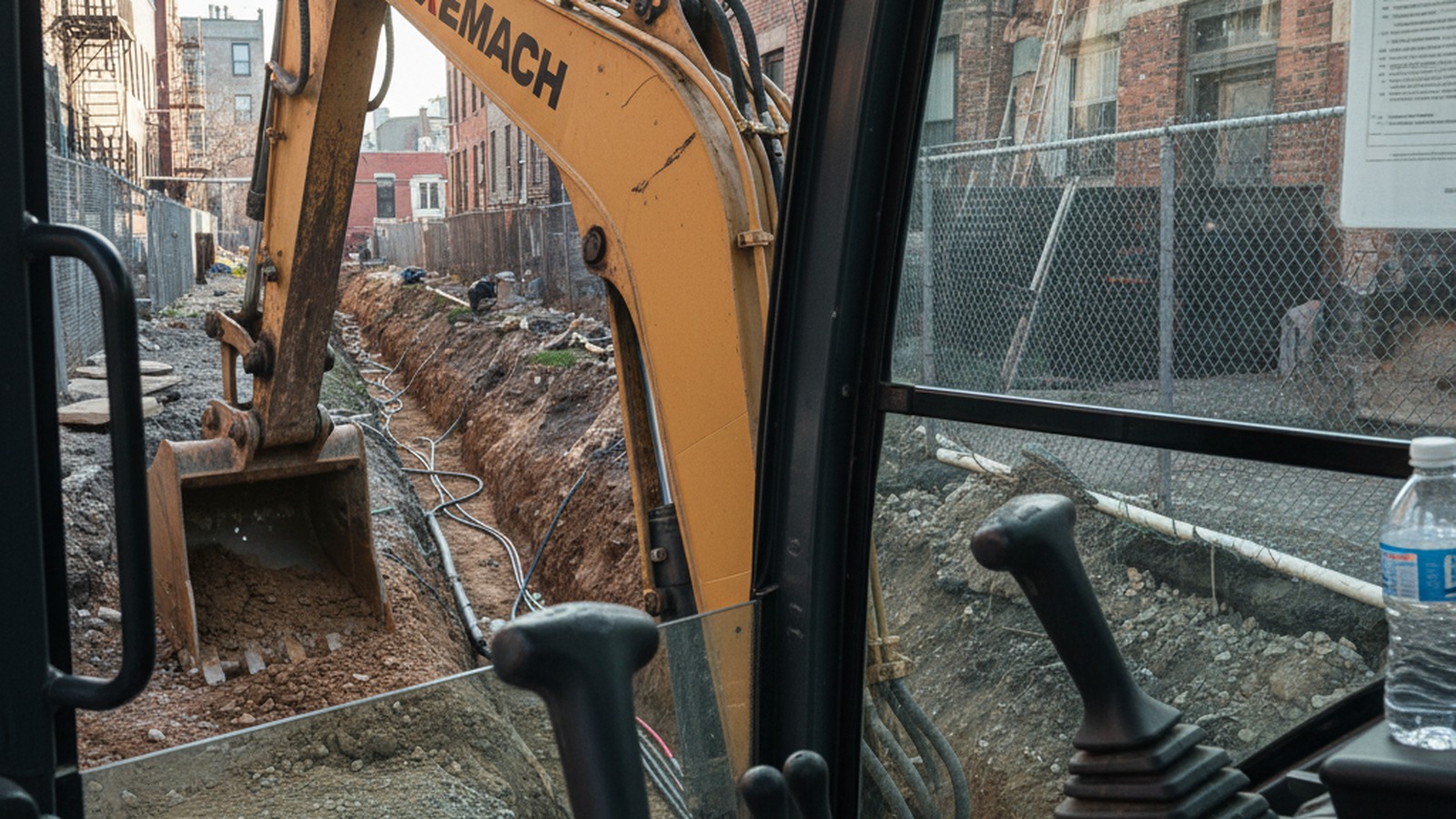
A utility contractor has 600 meters of trench to cut before the road closure window ends, and the hardest part is not breakout force. It is repeatability. The crew needs clean grade, predictable cycle times, fewer rework passes, and an operator who is still sharp at the end of a long, dusty shift. That is why autonomous excavator news matters now: the first serious use cases are showing up in exactly the kind of repetitive work that drains labor and margins.
Recent field reports suggest the conversation has moved beyond trade-show theater. Supervised autonomy is starting to prove itself in trenching, bulk excavation, and truck loading, while conventional crawler excavators are also gaining better cameras, obstacle detection, grade tools, and payload assistance. Put together, those changes point to a clear industry direction: excavators are becoming easier to guide, easier to monitor, and more realistic to automate task by task rather than all at once.
Why trenching is becoming the first real test case
Not every excavator application is a good candidate for autonomy. Demolition, mixed-material handling, and crowded urban work still depend heavily on human judgment. Trenching is different. The boundaries are easier to define, the motion repeats, and the production target is measurable.
That is why some of the most credible recent examples focus on trenching and mass excavation. One recent supervised-autonomy demonstration showed a mid-size excavator setting an excavation zone directly from the bucket, then running the trenching task from a tablet with a defined dump side and a safety boundary. Another active jobsite deployment has already moved more than 65,000 cubic yards with autonomous excavators loading human-operated articulated dump trucks in a normal earthmoving workflow.
Those examples matter for one reason: they do not ask contractors to imagine a science-fiction jobsite. They fit jobs that already exist. If autonomy can hold grade, repeat a cycle, stay inside a boundary, and work safely around a controlled loading pattern, then contractors can start evaluating it as a production tool rather than a concept video.
The operator is not disappearing; the job is changing
The lazy version of this story is “machines are replacing operators.” The more useful version is that the operator role is splitting.
On repetitive excavating work, the machine is taking over some of the motion planning, grade execution, and zone control. The human is moving toward supervision, exception handling, safety confirmation, and coordination with trucks, utilities, and other crews. In practice, that means the best systems are not the ones that try to hide the operator. They are the ones that make the operator faster when manual control is needed and less overloaded when the task is repetitive.
That lines up with a broader shift in the mid-size excavator market. New machine updates across the segment keep adding the same layers: larger in-cab displays, faster processing, easier 2D or 3D grade workflows, around-view cameras, radar-based obstacle detection, payload functions, and configurable electro-hydraulic controls. Even where full autonomy is not on the table, the machine is being prepared for more guided work.
This is the part buyers should pay attention to. The road to autonomy is not a single software switch. It starts with sensor placement, clean hydraulic response, reliable grade references, stable camera views, and operator trust in what the screen is showing.
What buyers should test before they believe the autonomy pitch
Autonomy on an excavator should not be judged by the demo alone. It should be judged by what happens when the trench gets dusty, the truck spots poorly, the haul route changes, or the utility map is incomplete.
A practical evaluation checklist looks like this:
- How quickly can the system define or import a dig zone?
- Can the operator move cleanly between assisted, supervised, and full manual control?
- What happens when the machine sees an obstacle, person, or unexpected edge condition?
- How accurate is the grade result after several cycles, not just one pass?
- Does the machine still feel predictable when using attachments or changing soil conditions?
- How serviceable are the cameras, radar, GNSS, and wiring on a muddy jobsite?
These questions sound basic, but they separate a strong field tool from a polished prototype. On real jobs, uptime and recovery behavior matter as much as the headline feature.
The next battleground is not autonomy alone
The bigger trend is that excavators are being redesigned around guided productivity. Autonomy is one branch of that tree. The others are just as important: payload feedback that helps loading crews avoid underfilling and overfilling; human detection that extends visibility in blind spots; virtual boundaries that reduce preventable contact; and digital design tools that shorten the path from drawing to finished trench.
That matters because many fleets will not buy autonomy first. They will buy safer cameras, easier grade assist, better attachment management, and cleaner data visibility. Then, once those pieces prove their value, supervised autonomy becomes less of a leap.
In other words, the market may adopt autonomous excavating the same way it adopted machine control: one practical workflow at a time.
What this means from a XeMach point of view
For manufacturers and fleet buyers, the signal is pretty straightforward. The excavators that will age best over the next few years are not only the ones with strong digging performance. They are the ones built for repeatable control, sensor-ready architecture, service-friendly wiring, and cabs that help operators trust digital guidance instead of fighting it.
The near-term opportunity is not to promise a fully driverless site. It is to build excavator platforms that make repetitive trenching, truck loading, and grade work less tiring, more consistent, and easier to scale when skilled labor is tight. That is where the industry looks serious today, and it is where buying decisions will start to shift.