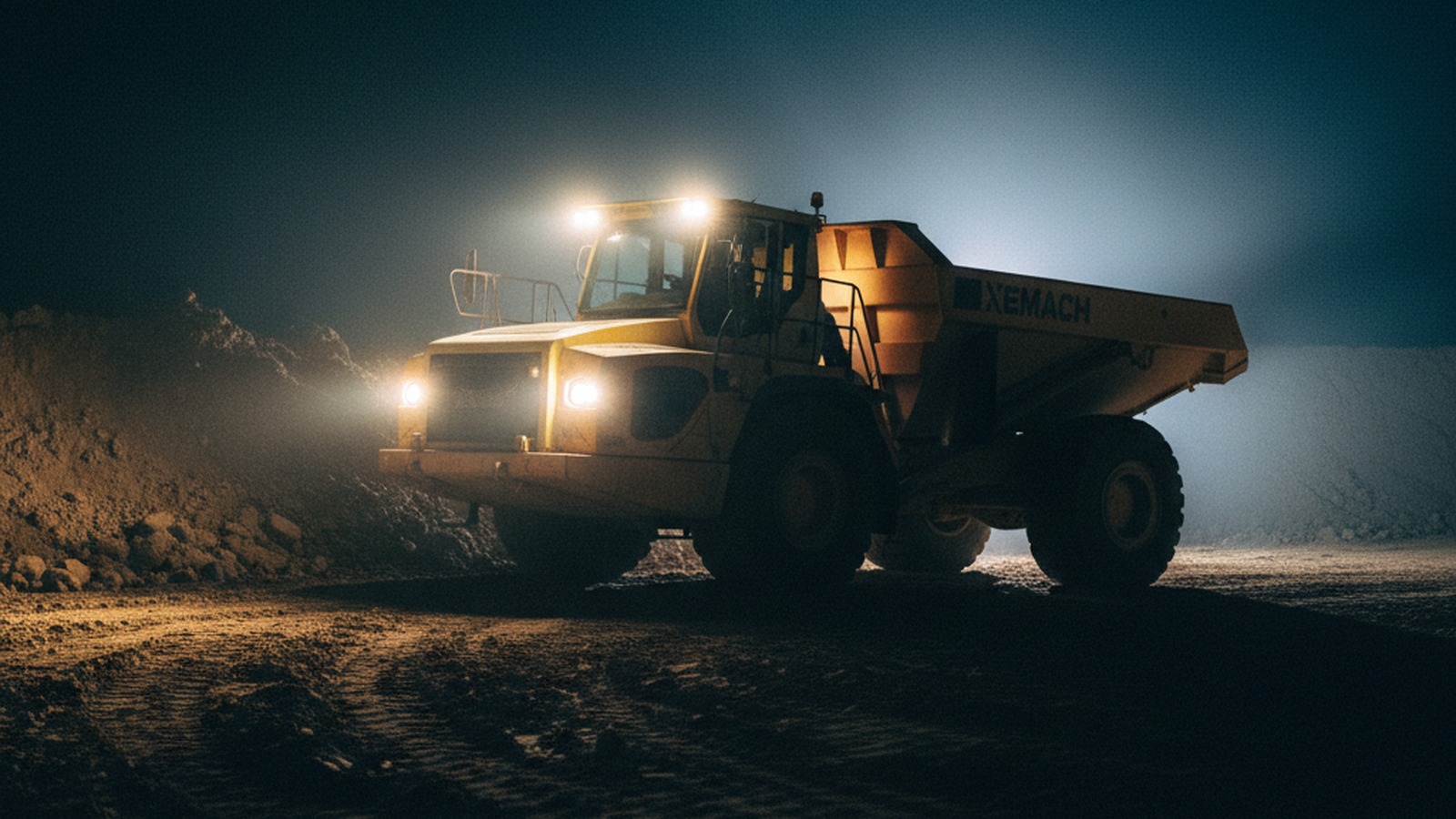
At one quarry, the haul loop is so repetitive that the site manager can tell you the loaded climb, the empty return, and the average wait at the crusher almost to the minute. That kind of predictability is exactly why electric articulated dump trucks are starting to look real in 2026, not just interesting.
A few years ago, battery-electric dump trucks in heavy earthmoving still felt like demonstration material: impressive on a stand, harder to picture on a punishing worksite. That is changing. Recent industry reporting points to the start of serial production for 30- and 40-ton electric articulated dump trucks, with early deliveries aimed at selected European customers and quoted operating windows of up to six hours in the right application.
That does not mean diesel haulage is about to vanish. It does mean the market has crossed an important line. Electric dump trucks are no longer only a prototype story. They are becoming a serious option for fleets that can match the machine to the route.
Why dump trucks suddenly look more practical than they did last year
The best electric machine categories all share the same trait: the work repeats. Wheel loaders got there early because yard cycles are predictable and charging can be planned. Dump trucks are now moving into that same logic, but only on the right sites.
A controlled quarry loop, a mine support road, or a plant-to-stockpile shuttle gives fleet managers something they rarely get on mixed jobsites: stable energy demand. Once the grade, payload, cycle time, and charging window are known, an electric truck can be planned like a production asset instead of a science project.
That is a big shift. In heavy equipment, technical feasibility is only half the battle. What matters is whether the machine can finish the shift without turning the whole site into a battery-management exercise. On fixed routes, the answer is starting to move from “maybe” to “sometimes yes.”
The site conditions that make or break the electric case
Electric articulated dump trucks will not win everywhere first. They need a narrow but meaningful set of conditions.
The strongest early-use cases usually look like this:
- repeated haul routes with limited route variation
- known payload bands instead of constant overload risk
- access to charging during shift changes or planned idle windows
- projects where noise or emissions already create operating friction
- fleets that can measure cycle data instead of relying on guesswork
That list explains why Europe is likely to stay an important early proving ground. Regulations matter, but so does job design. If a site is already disciplined about cycle control, electrification becomes far easier to test and scale.
Why excavators still have a harder road in larger classes
The contrast with excavators is useful. Compact electric excavators already make sense on urban utility jobs, indoor demolition, hospitals, and campuses. But once excavators get larger, the operating pattern becomes less friendly to batteries.
A bigger excavator may dig hard, idle, reposition, run an attachment, and then wait on trucks. The power demand moves around more. Charging access is often worse. And unlike a dump truck on a fixed loop, the machine is less likely to spend its day repeating the same cycle cleanly.
That is why electric dump trucks deserve more attention right now than many people expected. Not because they are easier machines in absolute terms. They are not. But on the right site, their duty cycle can be easier to model than that of a larger excavator.
Loaders still matter because they showed the playbook first
There is another reason this dump-truck moment matters: wheel loaders already showed what successful electrification looks like in construction machinery. Recent market reporting suggests battery-electric wheel loaders, especially in China, are scaling much faster than electric excavators because the jobs fit the technology better and the charging ecosystem is stronger.
Dump trucks are now borrowing from that playbook. Start where routes are repetitive. Start where charging can be engineered into the shift. Start where the cost of noise, fuel, or emissions is already visible. That is a far better path than trying to force electrification onto the most chaotic sites first.
What buyers should ask before they ask for a quote
Before a fleet asks for an electric dump truck price, it should answer a few operational questions honestly:
- How long is the real haul cycle under load, not the brochure version?
- Where will the truck charge, and what power is actually available on site?
- What happens on bad-weather days or when traffic builds at the dumping point?
- Is the fleet disciplined enough to track energy use shift by shift?
- Would the first electric truck solve a real site problem, or only create a marketing talking point?
Those questions are boring, which is exactly why they matter. Most expensive equipment mistakes begin when buyers fall in love with the category before they understand the duty cycle.
What this means for the next 18 months
The next stage of electrification in heavy machinery will not be won by the machine with the loudest launch. It will be won by the machine that can come back from a full shift with a business case that still makes sense.
From XeMach’s perspective, electric articulated dump trucks have now moved into the category of "watch closely, test carefully, and deploy selectively." For fleets with controlled haul routes, that is enough to justify serious evaluation right now. For everyone else, the smarter move is still the same: match the battery to the job, not the trend.