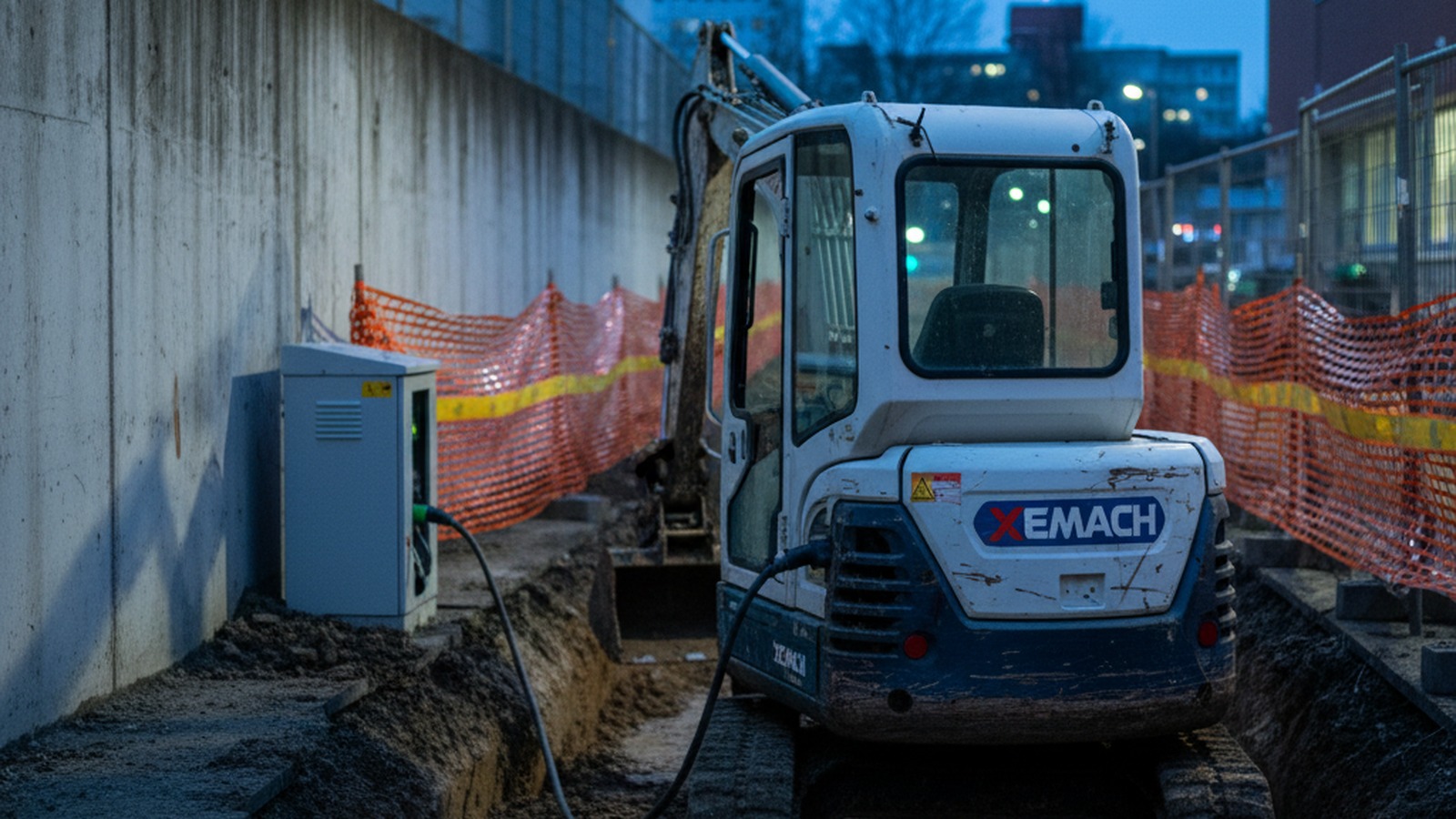
At 6:30 in the morning, a crew is opening a utility trench behind an operating hospital. The access lane is narrow, the neighbors are close, and the ventilation rules are strict. In that kind of job, the real question is no longer whether electric machinery exists. The question is whether an electric mini excavator can finish the shift without turning charging, runtime, and service support into a second project.
That is why electric mini excavators deserve more attention right now. Across heavy equipment, battery adoption is still uneven. Full-size machines remain expensive to electrify and difficult to charge in remote conditions. But compact excavators sit in a more practical middle ground: they work in short bursts, spend time repositioning, and increasingly operate in urban or enclosed environments where noise and exhaust have direct commercial consequences.
Why mini excavators are moving first
The market signals are becoming clearer. Recent industry reporting shows that battery-electric earthmoving equipment still represents only a very small share of sales in North America, roughly around 1% in the U.S. market. That sounds minor, and it is. But the detail that matters is where adoption is actually happening.
Mini excavators are among the earliest realistic use cases because their duty cycles are less punishing than those of larger excavators, dump trucks, or high-production loading machines. A compact unit does not spend every minute at peak load. It digs, slews, waits for a truck or crew, repositions, and starts again. That pattern fits battery systems much better than people assume when they compare machines only by maximum power.
The second driver is the jobsite itself. More contractors are working around schools, hospitals, residential utilities, indoor demolition areas, basements, tunnels, and municipal maintenance zones where low noise and zero tailpipe emissions are not just nice features. They affect permits, working hours, ventilation costs, and neighborhood complaints.
The runtime number is useful — but only if buyers read it correctly
Many electric mini excavators now promise roughly four to eight hours of operating time depending on the work cycle, with some newly launched production models in the market claiming close to seven hours on larger battery packs and faster recharge options during breaks. Those numbers are meaningful, but only when matched to the right type of job.
A drainage crew working in a dense city block may find that a machine can comfortably cover a shift because the excavator is not under continuous high load. A contractor cutting long hours in remote civil works will see a very different result. That gap is where many purchase decisions go wrong.
Buyers should be careful about three things.
- Rated runtime is not the same as real productivity in heavy hydraulic attachment work.
- Fast charging helps, but only if the site power supply is stable and planned in advance.
- Lower maintenance is real, but parts support and technician readiness still matter more than brochure claims.
In other words, electric mini excavators work best when the machine, charger, crew schedule, and site access are designed together.
Production maturity matters more than prototype excitement
For several years, electric excavators generated headlines without changing mainstream buying behavior. The difference now is that the conversation is shifting from demonstration units toward repeatable production models and clearer application fit.
That shift matters because buyers are no longer asking only, "Can this machine run?" They are asking tougher questions: How long will the battery hold up? Can it be charged from standard site power overnight? Is there a fast-charge path when turnaround is tight? Will the hydraulic feel match the diesel machine operators already know?
The broader electrification picture also supports this more cautious view. Industry analysis suggests electric wheel loaders are scaling faster than electric excavators in China, while excavator electrification remains concentrated mainly in mini classes. That is not a weakness. It is a reminder that electrification does not move evenly across all machine sizes. The early winners are usually the applications where infrastructure, regulation, and use patterns line up first.
What serious buyers should ask before comparing price tags
The wrong way to evaluate an electric mini excavator is to start with sticker price and stop there. The better approach is to map the machine to one specific work pattern.
Questions that matter more than list price include:
- How many hours per day is the machine actually digging under load?
- Is overnight charging realistic at the depot or the site?
- Does the job regularly happen indoors, near occupied buildings, or in noise-restricted zones?
- How often does the machine run breakers or other high-demand attachments?
- Can the fleet gain value from lower routine service complexity and reduced downtime around engine-related maintenance?
If the answer to most of those questions points toward predictable, compact, urban work, electric can already make operational sense. If not, diesel may still be the more economical choice today.
What this means for the next product cycle
The next phase of competition in electric excavators will probably not be won by the loudest launch. It will be won by manufacturers that can match battery size, charging options, attachment performance, and dealer support to a narrow set of high-probability jobs.
That is also where the opportunity is for exporters and private-label suppliers. Buyers in many markets are not asking for an electric machine just to look progressive. They are asking for a machine that solves a permit problem, extends working hours in sensitive zones, or lowers operating friction on repeatable compact jobs.
From XeMach's side, the takeaway is straightforward: electric mini excavators do not need to replace every diesel machine to become commercially important. They only need to be clearly better in the jobs they are built for. The suppliers that define those jobs precisely — and support them with realistic charging and service planning — are the ones most likely to turn curiosity into orders.