
At 6:30 a.m., your crew is standing on a tight urban jobsite with strict noise limits and a client asking for "zero tailpipe emissions." You need a mid-size crawler excavator that can run a full shift, keep cycle times consistent, and refuel quickly enough that it doesn't become tomorrow's downtime story.
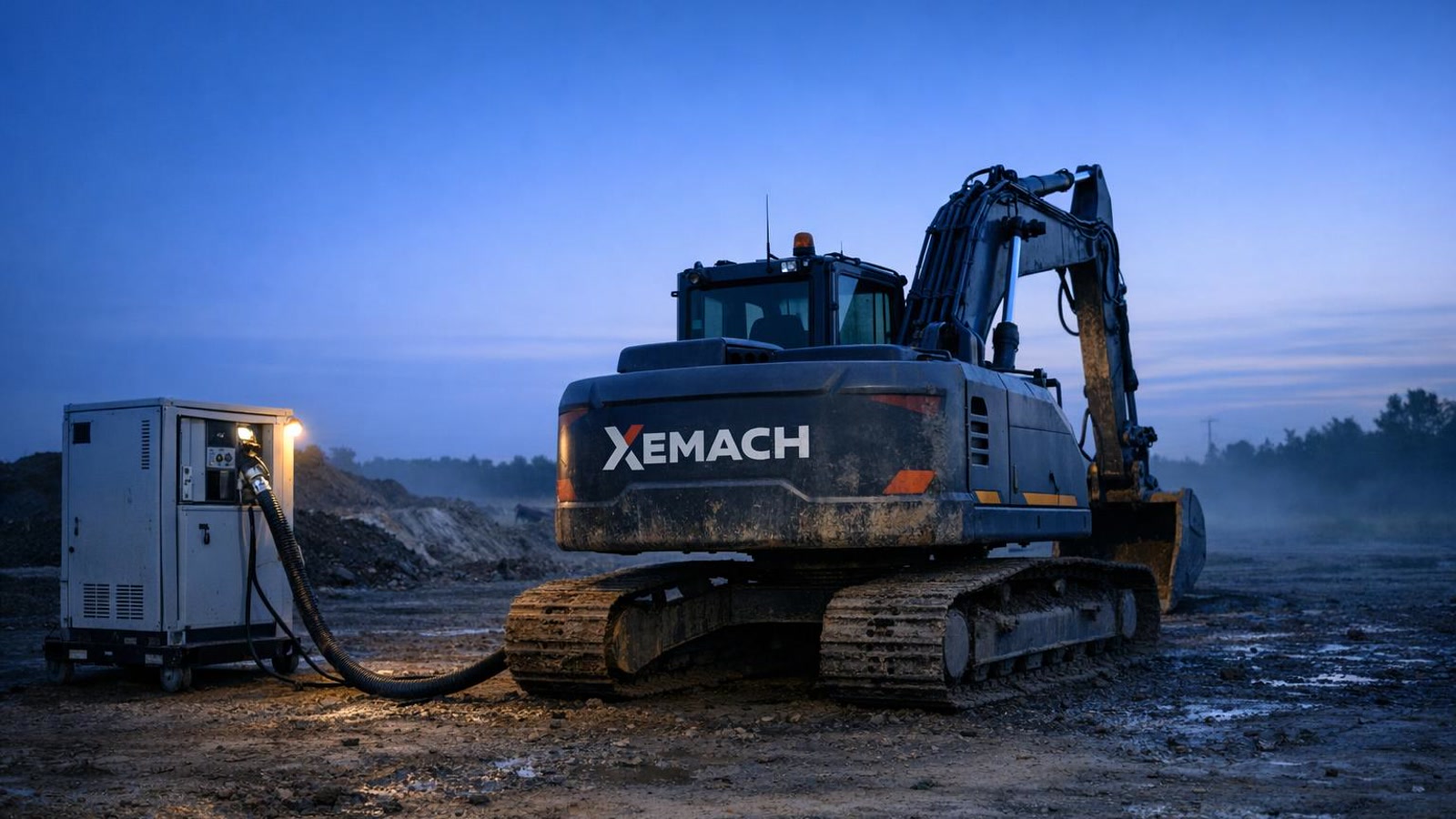
That's why hydrogen fuel cell excavators are getting serious attention again. A recent proof-of-concept trial of a medium-sized hydrogen fuel cell excavator reported diesel-like performance without tailpipe emissions, plus lower noise and vibration. It also surfaced the bottleneck everyone worries about: hydrogen supply and refueling speed.
Why fuel cells are being tested on mid-size crawler excavators
Battery-electric excavators already make sense in some places — compact machines, indoor work, and short duty cycles where charging is easy to plan. But as you move into heavier classes and longer runtimes, batteries grow fast in weight, cost, and charging demands.
Hydrogen fuel cells are being explored as another route to zero-tailpipe-emission excavators because they aim to deliver:
- longer runtime without oversized batteries (thanks to higher energy density in the fuel),
- a refueling workflow that looks more like today's fleet operations,
- water as the main byproduct at the machine.
For most contractors, the decision won't be "battery or hydrogen." It will be which setup fits the job, the site constraints, and the uptime plan.
What the latest jobsite trial signals (and what it doesn't)
In the reported trial, the fuel cell excavator was used for real work — relocating surplus soil and refueling on-site over a multi-day window. The headline takeaway is simple: performance can be close to a comparable diesel excavator, while operators benefit from lower noise and reduced engine-induced vibration.
Those operator comments aren't just comfort. Noise and vibration show up in productivity and safety:
- less fatigue over a long shift,
- clearer communication between operator and spotters,
- less "surge" feel when the powertrain response is smoother.
At the same time, the limits matter:
- Hydrogen infrastructure is the constraint. The trial reinforced the need for more commercial hydrogen supply.
- Refueling speed is the second constraint. Fast refuel is part of the promise, but jobsite refueling hardware and procedures still need to mature.
So this is not only an excavator technology story. It's a fuel + logistics + safety system story.
Buyers' checklist: what to ask before you spec a hydrogen excavator
If you're considering hydrogen (even as a pilot), treat it like a project. These questions separate a demo from a fleet plan.
What's your real duty cycle — and where does the energy go?
Track what actually burns fuel on your sites:
- sustained travel vs. repeated swing/boom cycles,
- heavy attachment use (for example, a hydraulic breaker) vs. light grading,
- idle time and warm-up patterns.
Fuel cell systems can behave differently under peak demand than a diesel with big transient reserve. Ask about cycle-time stability under your heaviest typical load cases.
How will refueling happen on your sites?
This is the make-or-break detail.
- Is hydrogen delivered to site, or do machines travel to a station?
- What refueling equipment is allowed, and who operates it?
- What is the expected refueling time per machine, and how does it change in cold weather?
If you can't answer these clearly, hydrogen will feel like downtime risk even if the excavator itself performs well.
What's the safety plan for storage, handling, and training?
Hydrogen adds new requirements:
- storage location and access control,
- leak detection and emergency response,
- operator and mechanic training,
- site rules (especially in dense urban areas).
Strong suppliers show up with a site-ready safety package, not just a brochure.
How serviceable is the system in the real world?
Ask where the new complexity lives:
- fuel cell stack service intervals,
- filtration and cooling circuits,
- diagnostics and fault isolation,
- inspection routines for high-pressure components.
The goal isn't "no issues." It's predictable maintenance and fast troubleshooting.
How hydrogen fits the broader multi-path transition
Construction won't decarbonize with a single technology. Several pathways are likely to coexist:
- cleaner diesel plus renewable drop-in fuels (like HVO) to cut emissions in existing fleets,
- battery-electric excavators expanding where charging is workable and noise constraints are strict,
- hydrogen fuel cells or hydrogen combustion targeting heavier classes and longer runtimes.
Procurement will start looking less like "choose a brand" and more like "choose an energy strategy by job type."
XeMach take: plan the transition around uptime, not headlines
From a XeMach perspective, hydrogen fuel cell excavators are most interesting where batteries are hardest to deploy: longer shifts, heavier classes, and sites that can't spare long charging windows. The early winners won't be the teams with the best press release. They'll be the teams that design the logistics first — fuel delivery, refueling workflow, safety, and service support — and then spec the machine.
If you're evaluating next-generation excavators this year, a practical next step is a simple internal audit:
- pick one repeatable job type (soil relocation, trenching, quarry support),
- document the duty cycle and today's fuel burn,
- map what refueling would look like under real site constraints,
- compare hydrogen vs. battery vs. low-carbon liquid fuels on cost per hour and downtime risk.
That's how "future tech" becomes a fleet decision.
\n
\n