
Kubota FY2025 Regional Demand Signals: Why Compact Equipment Growth Diverged by Region—and What FY2026 Targets Tell Us
Lead
Kubota FY2025 performance — the numbers (in $) and why they matter
Timing: Kubota published its FY2025 full‑year results on February 12, 2026 (FY2025 year ended December 31, 2025). Before we talk about “why” each region moved, it’s worth grounding the discussion in the headline numbers, then the product‑line and regional splits—and finally what the FY2026 targets imply.
All figures below are converted at ¥145 = $1 (management’s FY2026 FX assumption) and rounded.
- Net sales: $20.82bn (+0.1% YoY)
- Operating profit: $1.83bn (−15.9% YoY); operating margin 8.8% (vs 10.5% in FY2024)
- Profit attributable to owners of the parent: $1.29bn (−19.0% YoY)
At an industry level, the headline is “flat revenue, lower profit.” That usually points to a mix of (1) pricing/cost pressures (tariffs, inflation), and (2) volume/mix softening in the most margin‑sensitive product groups.
By product line / segment
- Farm & Industrial Machinery: net sales $18.13bn (−0.3% YoY); operating profit $1.75bn (−21.6% YoY). (This segment includes farm equipment, ag‑related products, engines, and construction machinery.)
- Water & Environment: net sales $2.58bn (+3.2% YoY); operating profit $0.23bn (+35.9% YoY).
- Other: net sales $0.11bn (−5.1% YoY); operating profit $0.01bn (−14.7% YoY).
What this signals for construction machinery: construction equipment can look “steady” on end‑demand, but still deliver weaker profit when incentives, freight, and tariff‑related costs move against the OEM—or when mix shifts away from higher‑margin configurations.
By region (Machinery segment)
- Japan: $2.45bn (up about $0.30bn YoY)
- North America: $8.25bn (down about $0.40bn YoY)
- Europe: $2.39bn (up about $0.11bn YoY)
- Asia & Others: $5.05bn (down about $0.06bn YoY)
Management commentary links North America’s weakness to an overall tractor market decline and deliberate inventory reduction, while noting construction machinery demand was comparatively steadier—suggesting the channel (and product mix) mattered as much as the jobsite.
FY2026 targets: what Kubota is guiding for (in $) and what to watch
- Net sales (forecast): $21.72bn (+4.3% vs FY2025)
- Operating profit (forecast): $2.07bn
- Profit attributable to owners (forecast): $1.45bn
- Assumed FX rates: ¥145/$ and ¥165/€
The guidance implies a profitability rebound that depends on higher overseas sales, a steadier North America, European recovery, and Asia growth (India strength, Thailand recovery), plus further price adjustments/incentive discipline to offset tariff and inflation pressures.
A single OEM's financial disclosures won't tell you everything about the construction equipment cycle—but they can show where demand is cooling, where dealers are tightening inventory, and which product lines are still carrying results. In a recent FY2025 business report, Kubota highlighted a familiar split: North America softness (especially tractors) versus stronger contributions from construction machinery and the domestic (Japan) market.
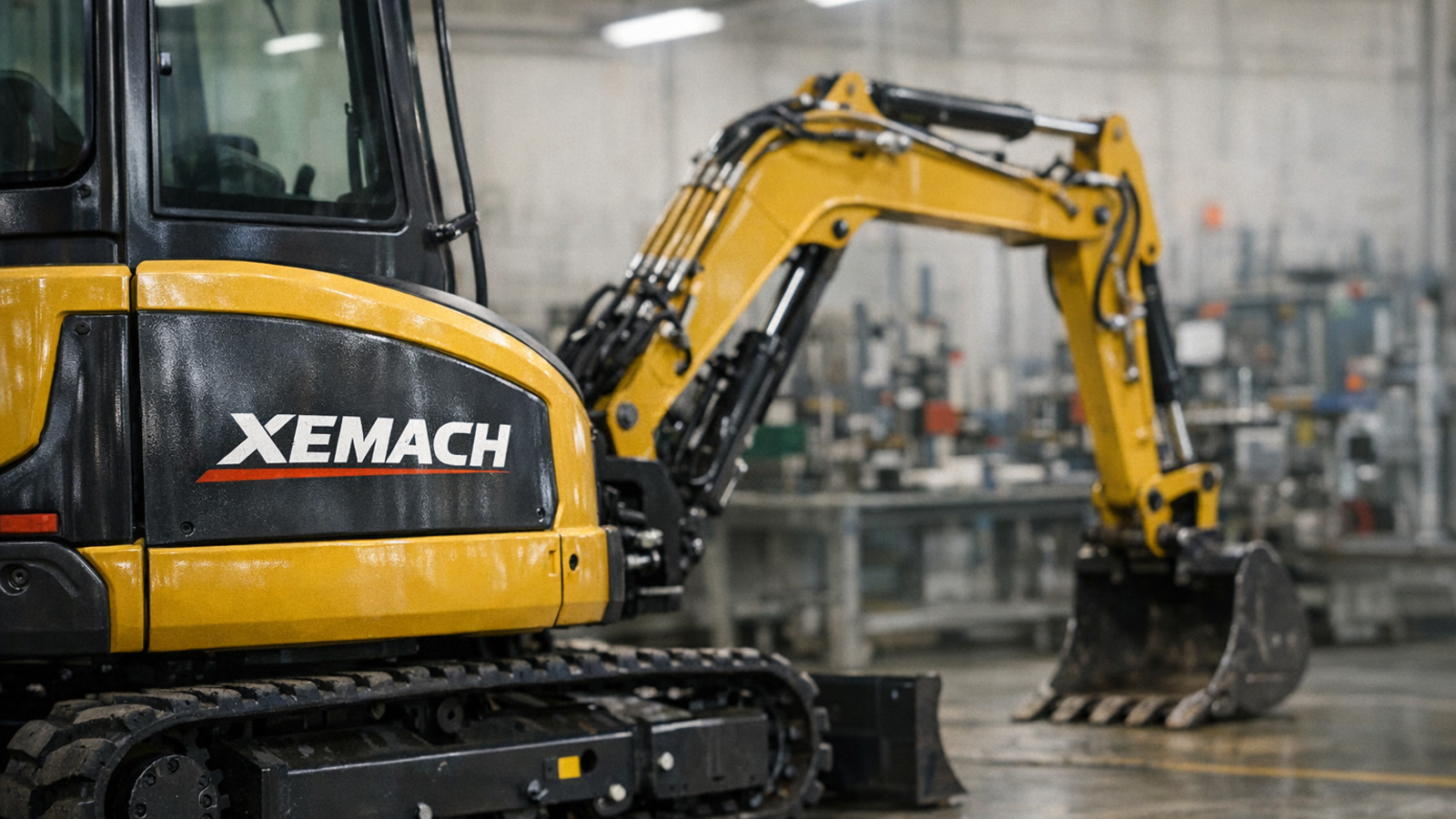
From a XeMach perspective, the takeaway is not about one brand's performance. It's about what the underlying drivers suggest for mini excavators, crawler excavators, wheel loaders, and tractors in the next 2–3 quarters: inventory discipline in the Americas, selective resilience in compact construction equipment, and an ongoing push to defend margins through competitiveness and product mix.
1) Americas: inventory discipline is the headline (not just end-demand)
Kubota states it "limited shipments to prevent an increase in distribution inventory," which it ties to a year‑on‑year decline in revenue and operating profit in North America. This kind of wording is a strong signal that the channel—dealer inventory, not only retail orders—has become the limiting factor.
What this often means for compact equipment buyers and sellers
- Mini excavators / compact loaders: When OEMs slow shipments, lead times can normalize quickly, but discounts do not always appear immediately. Dealers may prioritize moving aging inventory first.
- Attachment demand can lag: Couplers, breakers, and hydraulics-related attachments usually follow machine use. If shipments are constrained, attachment sales can soften 1–2 quarters later.
- Used market stays "busy" longer: If new shipments are managed, contractors may keep older units in rotation, supporting parts and service activity.
2) Tractors: a specific downturn matters to construction-adjacent demand
Kubota also notes a "downturn in the North American tractor market," and says this affected its consolidated forecast. Tractors sit at the intersection of agriculture, landscaping, and light construction—so a tractor slowdown can coincide with weaker small-contractor spending and tighter financing.
Why construction machinery teams should care
- A tractor dip can be an early warning for entry-level equipment purchases that compete for the same capital budgets as mini excavators.
- If finance rates or credit standards are the driver, the impact can spread to compact excavators and small wheel loaders even when project backlogs look stable.
3) Japan / Asia-Oceania: construction machinery is still carrying weight
In contrast, Kubota says performance was "supported by strong results in construction machinery" and domestic agricultural machinery. Even without a region-by-region table in the excerpted disclosures, the language matters: management is explicitly leaning on construction machinery as a support pillar.
What we read into that (carefully)
- Fleet renewal continues in pockets: When an OEM calls out construction machinery as a support factor, it often reflects ongoing replacement demand—smaller fleets upgrading for reliability, emissions compliance, or operator comfort.
- Product mix becomes more important than volume: Strong "results" can come from better mix (higher-spec machines, popular sizes) rather than a broad-based unit boom.
4) The strategic tell: expand construction machinery, restore tractor profitability
Kubota's forward-looking comment is blunt: it aims to "further expand" construction machinery while "enhancing the competitiveness" of its tractor business to restore profitability.
For the market, this points to two trends we expect to keep seeing across OEMs:
- More intensity in the compact equipment segment (mini excavators, small crawler excavators, compact wheel loaders) where global demand is structurally larger and product refresh cycles are short.
- Margin protection over volume chasing, with pricing discipline and tighter dealer stocking policies—especially in North America.
5) XeMach view: what to watch in the next 2–3 quarters
If you sell, service, or operate excavators and compact equipment, here are a few practical signals to monitor:
- Dealer inventory days (Americas): shipment controls usually mean dealers are already carrying enough stock.
- Compact excavator lead times: the fastest indicator of whether OEMs are still constraining supply.
- Attachment use (breakers, couplers): a delayed but reliable indicator of real jobsite activity.
- Financing approvals for small contractors: tractors often react first; mini excavators can follow.
Closing
The main point isn't that the cycle is "up" or "down" everywhere at once. It's that 2025–2026 demand is increasingly regional and channel-driven. For excavators and compact equipment, the winners will be the teams that manage inventory carefully, keep product specs aligned to jobsite needs, and stay ready to pivot by region rather than betting on a single global narrative.
Sources