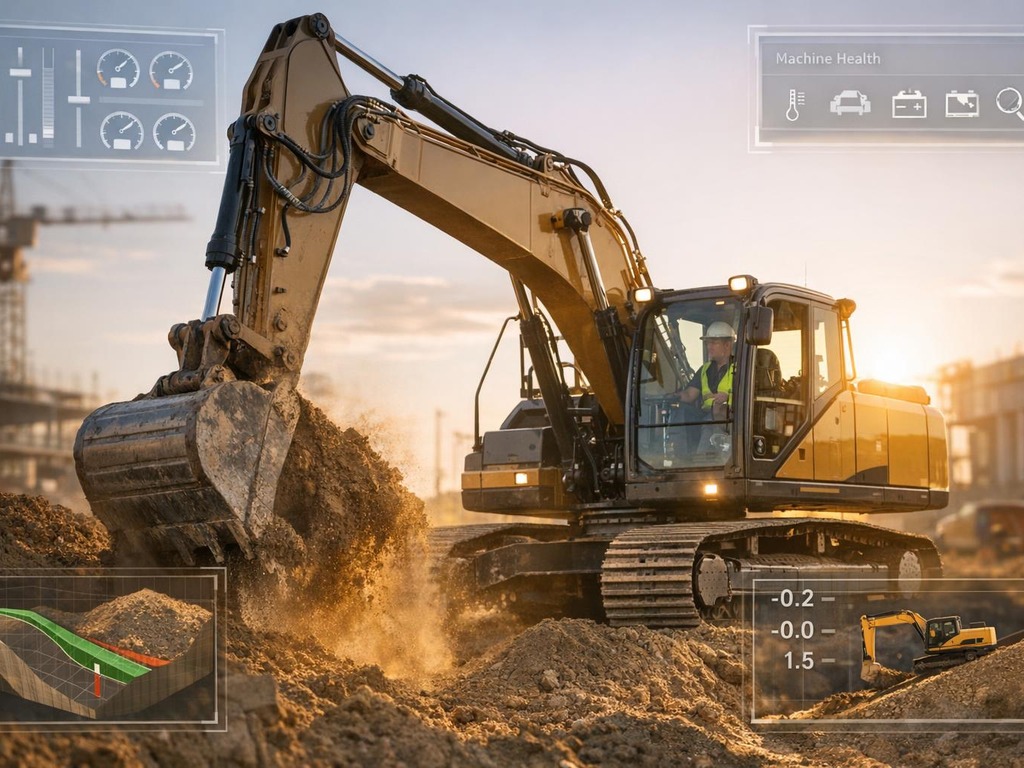
Key takeaway: New-generation excavators are no longer competing on raw digging force alone. OEMs are bundling electrohydraulic controls, factory-installed machine-control “upgrade paths,” and operator-assist safety into the base machine—pushing buyers to evaluate total lifecycle productivity rather than sticker price.
ConExpo 2026 is shaping up to be a clear inflection point for the excavator market. Multiple announcements over the past two weeks point to the same direction: the next purchasing cycle will be driven by smarter hydraulics, easier-to-scale grade control, and built-in monitoring that protects uptime.
1) Electrohydraulic controls are moving from “premium” to “expected”
HD Hyundai’s next-generation HX excavators for the North American market highlight fully electrohydraulic (FEH) controls as a cornerstone. In practical terms, FEH can translate into more consistent lever feel, smoother fine grading, and easier tuning across operators—especially valuable for fleets that rotate operators across machines.
From a XeMach perspective, FEH also matters because it becomes the platform for software-defined functions: pump/valve coordination, selectable response curves, and automation features that can be delivered through updates and option packages over the machine’s life.
2) Factory integration is becoming the fastest path to 2D/3D machine control
Another strong signal is the expanding Leica–Liebherr collaboration: a factory-integrated sensor chain across Generation 8 mobile and crawler excavators, with 2D guidance available through the OEM display and a clear upgrade route to 3D machine control later.
This “2D standard + 3D-ready option” approach reduces downtime and installation friction, and it changes how contractors should spec machines: not just “Do I need 3D today?” but “Can I upgrade cleanly in 12–24 months when workload or customer requirements change?”
3) Safety-assist is being packaged with productivity features
On the new HX lineup, HD Hyundai emphasizes boundary warning functions, health monitoring, and optional camera/AI detection systems. Across the industry, these tools are increasingly positioned not as compliance extras, but as cycle-time protectors—reducing near-miss slowdowns, unplanned stops, and incident-driven downtime.
For excavator buyers, the practical question is whether the safety stack is integrated (single in-cab UI, shared sensors) or bolted on. Integrated systems tend to be easier to maintain and more likely to stay enabled in real-world use.
What this means for contractors and rental fleets
- Spec for upgradeability: Choose excavators that are 3D-ready or have OEM-approved upgrade kits, even if you start with 2D.
- Evaluate the “operator variability” problem: FEH and configurable control profiles can help standardize performance across different operators.
- Count downtime as a cost center: Factory integration and longer service intervals can be as important as fuel burn in total cost of ownership.
XeMach outlook
We expect 2026 excavator purchasing decisions to shift toward platforms—machines that can be configured, updated, and upgraded over time. In that environment, the winners will be OEMs and suppliers who reduce integration pain and help fleets scale from basic guidance to semi-automated workflows without taking machines out of service.